
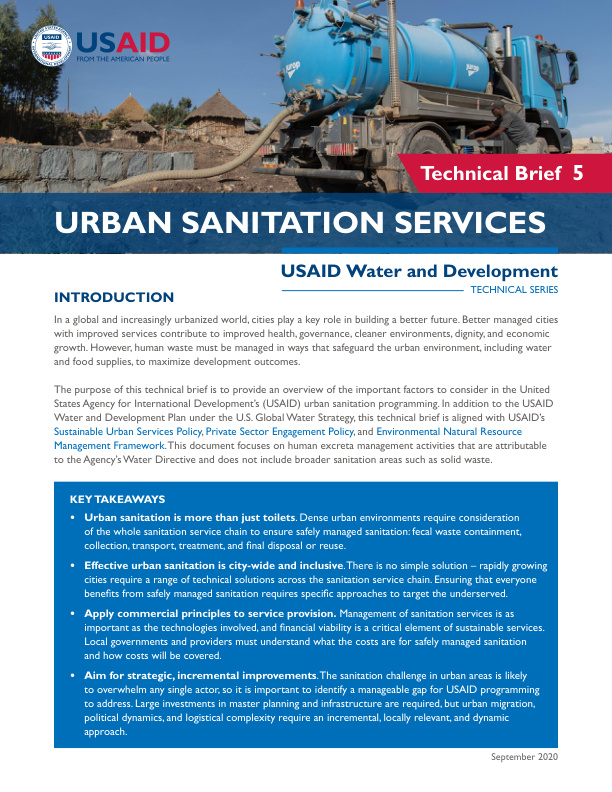
This Water and Development Technical Brief provides an overview of the important factors to consider in USAID’s urban sanitation programming.
This brief is part of USAID ‘s Water and Development Technical Series, which provides guidance on important topics for developing and implementing water and sanitation activities in support of the U.S. Government Global Water Strategy and USAID’s plan under the strategy.
In a global and increasingly urbanized world, cities play a key role in building a better future. Better managed cities with improved services contribute to improved health, governance, cleaner environments, dignity, and economic growth. However, human waste must be managed in ways that safeguard the urban environment, including water and food supplies, to maximize development outcomes.
The purpose of this technical brief is to provide an overview of the important factors to consider in USAID urban sanitation programming. This document focuses on human excreta management activities that are attributable to the Agency’s Water Directive and does not include broader sanitation areas such as solid waste.
KEY TAKEAWAYS- Urban sanitation is more than just toilets. Dense urban environments require consideration of the whole sanitation service chain to ensure safely managed sanitation: fecal waste containment, collection, transport, treatment, and final disposal or reuse.
- Effective urban sanitation is city-wide and inclusive. There is no simple solution – rapidly growing cities require a range of technical solutions across the sanitation service chain. Ensuring that everyone benefits from safely managed sanitation requires specific approaches to target the underserved.
- Apply commercial principles to service provision. Management of sanitation services is as important as the technologies involved, and financial viability is a critical element of sustainable services.
- Local governments and providers must understand what the costs are for safely managed sanitation and how costs will be covered.
- Aim for strategic, incremental improvements. The sanitation challenge in urban areas is likely to overwhelm any single actor, so it is important to identify a manageable gap for USAID programming to address. Large investments in master planning and infrastructure are required, but urban migration, political dynamics, and logistical complexity require an incremental, locally relevant, and dynamic approach.
