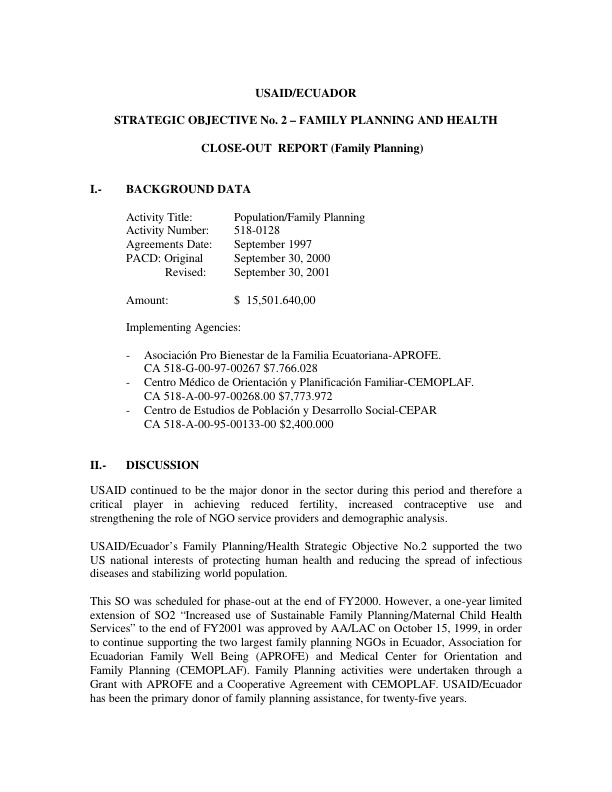
Mission close-out report on activities (9/97-9/01) in support of strategic objective (SO) 2 — to promote family planning (FP) in Ecuador. FP activities were carried out by two NGOs — Asociacion Pro Bienestar de la Familia Ecuatoriana (APROFE) and Centro Medico de Orientacion y Planificacion Familiar (CEMOPLAF). Health activities under SO 2 — including financing for Centro de Estudios de Poblacion Y Desarrollo Social (CEPAR) ended 9/00 as planned. USAID support has helped APROFE and CEMOPLAF grow from being small regional organizations to national importance with 21 clinics each. Key overall results were as follows: (1) Consolidation of FP NGOs hard hit by financial constraints was increased in 1999-2000 (through an additional $1.1 million for contraceptives and logistics technical support in FY 2001). These local NGOs managed to make a significant recovery in late FY 2000 and early FY 2001 and still attracted a growing clientele to their private clinics. Cost recovery targets were met despite these severe challenges, with an average of over 90% for APROFE and CEMOPLAF. (2) Thanks to the special emphasis given to institutional strengthening, both NGOs have solid administration and empowered management staff in preparation for USAID phase- out. (3) Contraceptive prevalence rate (CPR), the primary measure of SO results, increased significantly, from 56.8 in 1994 to 66.3 in 1999. Also, the total fertility rate declined from 3.6 in 1994 to 3.3 in 1999 (a modest but significant decline). Some 61% of FP users now obtain contraceptive services from private sources, and 36.6% of contraceptive use is for female sterilization, of which the Ministry of Health (MOH) provides over 60%. (4) CEPAR, with TA from the Centers for Disease Control (CDC), carried out, in both 1994 and 1999, the nation”s most widely representative and respected demographic and reproductive health survey, ENDEMAIN, the largest survey of its kind in Latin America. (5) National Reproductive Health Services Guidelines were prepared and disseminated, with JHPIEGO taking the lead in coordinating the many participant institutions. (6) A quality index of seven factors was applied and accomplished by 42 APROFE and CEMOPLAF clinics. These factors are: stockouts of any method/brand; at least three modern methods available; private exam space in facility; staff trained in methods available in counseling and on side effects; state-of-the-art national guidelines available onsite; facility staffed and open at least 5 hours per day; and staff trained on handling/disposal of medical wastes. (7) Cost recovery levels of both assisted NGOs continued to increase even during the economic crisis of the late 1990s and 2000. The amounts deposited in the sustainability fund show the great efforts made by local partners to recover costs while maintaining their social mission to serve the poor and lower middle class. Specific achievements by each NGO are noted in the report. Lessons learned are as follows: (1) Because Ecuador experiences rapid political, economic, and social changes, project success should be measured beyond target figures and should include indicators such as transparency in management and solid leadership. (2) Long-term actions are required to prepare local partners for self-sustainability, with attention to long-term institutional strengths and weaknesses. (3) TA should be focused in institutional strengthening, as most of the local NGOs begin as family organizations, where nepotism is a daily practice and businesslike management practices uncommon. (4) Project indicators should include measures for institutional strengthening. (5) Although FP coverage increased for both NGO partners, the poorest populations are generally still far away from the services. The number of participating partners should be increased in order to expand the access of services. (6) Local NGO partners were urged to achieve self-sustainability; this forced them to increase the prices of health and FP services and practically abandon many of the original target population — the poor and the marginalized, especially women. (7) The accomplishment of project indicators does not reflect an entire institution”s performance. It could be a performance of a group of employees but not a result of a well-managed organization. Indicators not included in the Mission Performance Monitoring Plan should be tracked in order to evaluate other efforts of the institution. (8) Despite reports received by the Mission, it is particularly important to work closely with the NGOs to identify their strengths and weaknesses and to address assistance accordingly.

