USAID
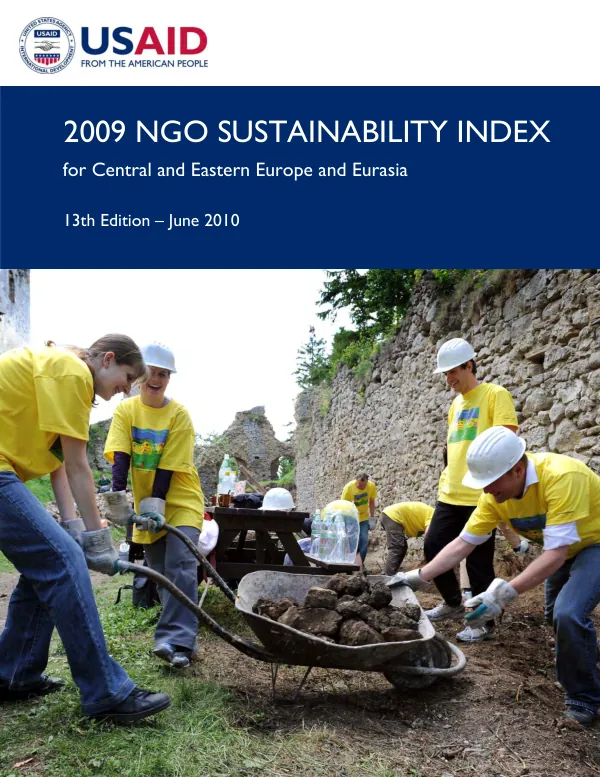
2009 NGO Sustainability Index for Central and Eastern Europe and Eurasia
The 2009 NGO Sustainability Index for Central and Eastern Europe and Eurasia is a comprehensive assessment of the sustainability of non-governmental organizations (NGOs) in the region.
2010 · 255 pages
Sign in to readA free account is required to download.
Abstract
The index is developed by the United States Agency for International Development (USAID) Bureau for Europe and Eurasia Office of Democracy, Governance and Social Transition. The index evaluates NGOs in 25 countries across the region, categorizing them into three tiers: Northern Tier, Southern Tier, and Eurasia. The Northern Tier includes countries such as the Czech Republic, Estonia, and Poland, while the Southern Tier includes countries such as Albania, Bosnia and Herzegovina, and Kosovo. Eurasia includes countries such as Russia, Ukraine, and Belarus. The index assesses NGOs in six dimensions: Legal Environment, Organizational Capacity, Financial Viability, Advocacy, Service Provision, and Infrastructure. The Legal Environment dimension evaluates the regulatory framework governing NGOs, while Organizational Capacity assesses the NGOs' ability to manage resources and implement programs. Financial Viability evaluates the NGOs' financial stability and sustainability, while Advocacy assesses their ability to influence policy and promote social change. Service Provision evaluates the quality and effectiveness of the NGOs' programs and services, and Infrastructure assesses their ability to access resources and support. The index provides a comprehensive picture of the strengths and weaknesses of NGOs in the region, highlighting areas where they excel and areas where they need improvement. The results of the index are presented in a table, which shows the average scores for each country in each dimension. The index also includes a section on country reports, which provide a detailed analysis of the NGOs in each country. These reports provide a more in-depth look at the NGOs' performance in each dimension and highlight areas where they need improvement. The 2009 NGO Sustainability Index is an important tool for policymakers, donors, and NGOs themselves, providing a comprehensive assessment of the sustainability of NGOs in the region. The index highlights the importance of a strong legal environment, organizational capacity, and financial viability for NGOs to be effective and sustainable. The index also highlights the challenges faced by NGOs in the region, including a lack of transparency and accountability, limited access to resources, and a difficult regulatory environment. However, the index also highlights the strengths of NGOs in the region, including their ability to promote social change and influence policy. Overall, the 2009 NGO Sustainability Index provides a comprehensive picture of the sustainability of NGOs in Central and Eastern Europe and Eurasia, highlighting areas where they excel and areas where they need improvement. The index is an important tool for policymakers, donors, and NGOs themselves, providing a framework for understanding the challenges and opportunities facing NGOs in the region. The index also includes a section on articles, which provide a more in-depth look at specific issues and challenges facing NGOs in the region. The articles highlight the importance of technology in changing the civil society landscape in Central and Eastern Europe and Eurasia, and the need for NGOs to adapt to these changes in order to remain effective and sustainable. The 2009 NGO Sustainability Index is a valuable resource for anyone interested in the sustainability of NGOs in Central and Eastern Europe and Eurasia. The index provides a comprehensive picture of the strengths and weaknesses of NGOs in the region, highlighting areas where they excel and areas where they need improvement.
Related documents