USAID DEC
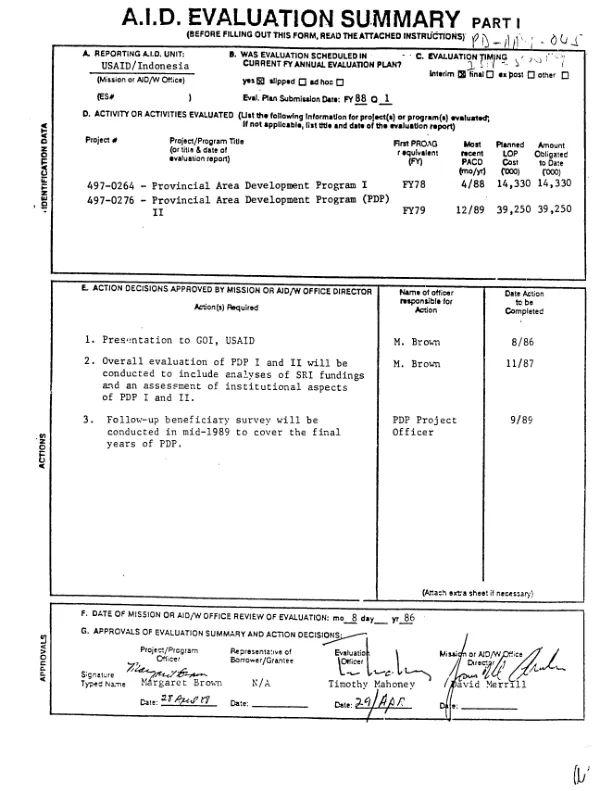
497-0264-provincial area development program I, 497-0276-provincial area development program (PDP) II
Sign inUSAID. MISSION TO INDONESIA
497-0264-provincial area development program I, 497-0276-provincial area development program (PDP) II
Summarizes attached special evaluation of a project to promote decentralized regional and rural development in Indonesia through a series of relatively small-scale projects planned and implemented at sub-national levels.
1988
Sign in to readA free account is required to download.
Abstract
Interim evaluation covers the period 1978-5/86. Interviews were conducted with a random sample of beneficiaries; additional interviews were held with project officials, village headmen, and non-beneficiaries for the purposes of comparison. The project is operating in 44 districts, assisting some 400 development activities a year in such areas as village credit, institution building, crop and livestock production, fisheries, irrigation, and small industry and business. Results in the three areas targeted by the evaluation (i.e., identification of beneficiaries, the amount of benefits accrued, and their sustainability) were varied. A demographic profile of project beneficiaries revealed that 85% are self-employed, 69% are literate in Bahasa Indonesia, 51% are over 40 years of age, and 92% are male. Based on a relative index of poverty, it was found that 67% of the project beneficiaries are appropriately targeted, 15% could be classified as borderline, and 17% are outside of the primary target group. Because indirect beneficiaries were not counted, however, the total benefits of the project may be under-claimed. Project activities have produced quantifiable gains. At the end of the first year or first harvest of a project activity, the average incremental gain in profits for new and continuing project participants together was Rp. 59,000. Overall, the data show that the gains achieved in the first year have generally been sustained until the present time. A cost-benefit ratio (the average annual net gain derived from one unit of direct cost) was calculated to be .69 for the project. Using net gains over time as a measure of the project"s sustainability, it was found that only 10% of project activities have been discontinued, with a further 3% expected to be brought to an end. Using beneficiaries" anticipated income and opinions as a measure, it was found that 25% of selected beneficiaries have quit or expect to quit project activities soon. Using current project status and annual net gain as a measure, 45% of beneficiaries are classified as working in highly or moderately sustainable activities, 31% were in the unsustainable category, and the sustainability status of 24% was undeterminable. No recommendations are provided as their drafting was not within the mandate of the evaluation team. A subsequent analysis will use the evaluation as part of a base for making recommendations. No comments were provided by the Mission. (Author abstract, modified)