USAID DEC
7 MW Kvernaki Solar Power Project Feasibility Study Parameters
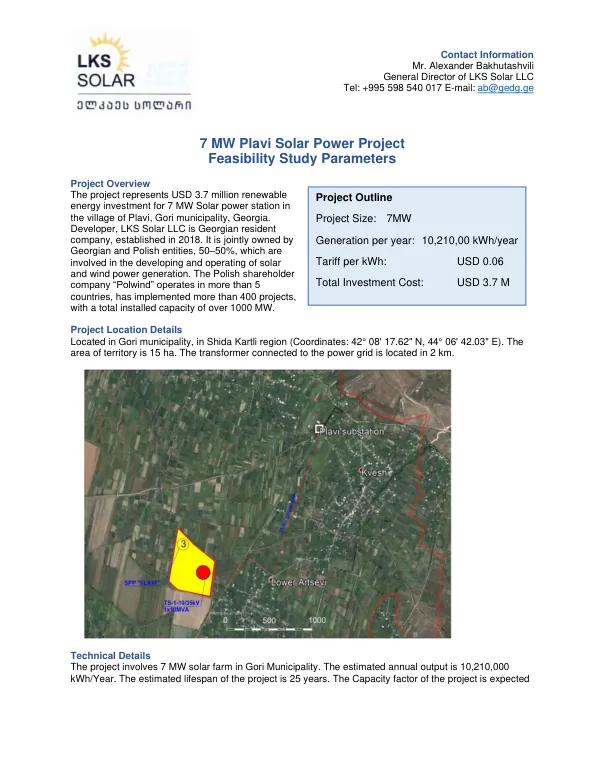
The Kvernaki Solar Power Project is a 7 MW renewable energy investment located in the village of Plavi, Gori municipality, Georgia.
2021 · 4 pages
Sign in to readA free account is required to download.
Abstract
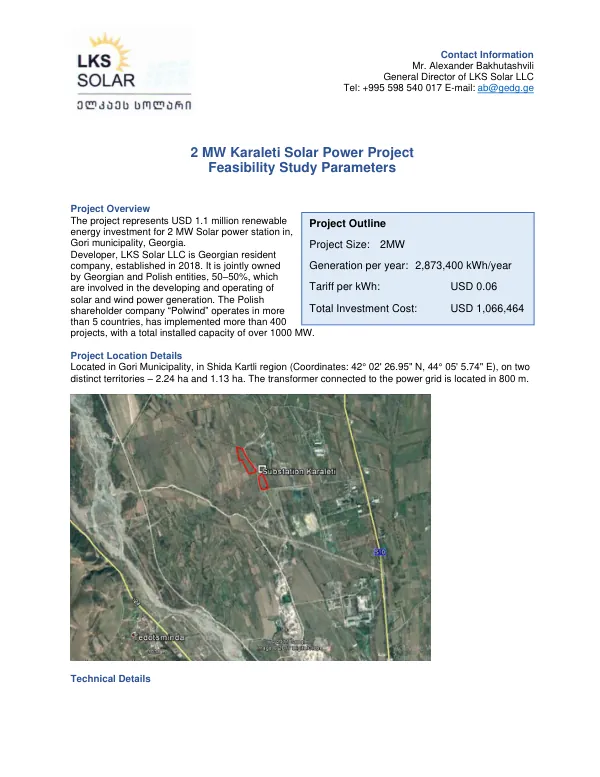
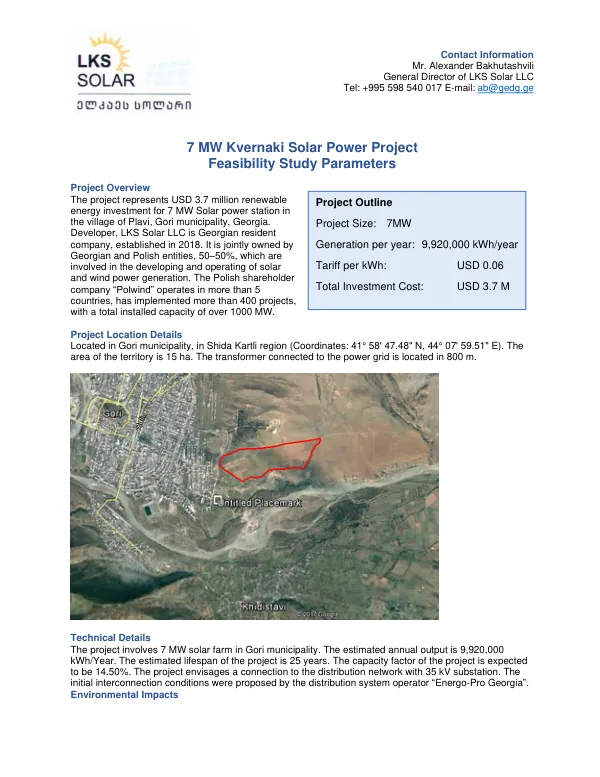
The project is being developed by LKS Solar LLC, a Georgian resident company established in 2018, which is jointly owned by Georgian and Polish entities. The Polish shareholder company, Polwind, operates in more than 5 countries and has implemented over 400 projects with a total installed capacity of over 1000 MW. The project site is situated in the Shida Kartli region, with coordinates 41° 58' 47.48" N, 44° 07' 59.51" E. The area of the territory is 15 ha, and the transformer connected to the power grid is located 800 m away. The project involves a 7 MW solar farm, with an estimated annual output of 9,920,000 kWh/year. The estimated lifespan of the project is 25 years, with a capacity factor of 14.50%. The project will reduce carbon emissions by 77,800 tons. The main impacts of the project in the construction and operation phases include emissions of carbon monoxide, nitrogen oxide, particulate matter, and suspended dust due to transport, construction equipment, and generators. Land use change and land degradation, soil contamination with oils and petroleum, intensive water use, and deterioration of surface water quality are also expected. However, these impacts can be mitigated or minimized with proper measures. The project is expected to commence operation in 2023, with a planned date of signing the Memorandum of Understanding in 2021. Priority will be given to the employment of local people during the construction phase, and up to 25 people are expected to be employed during the operation phase. The project will be connected to the distribution network with a 35 kV substation, and the initial interconnection conditions were proposed by the distribution system operator, Energo-Pro Georgia. The project's technical parameters include a 7,000 kWp installed PV plant capacity, with a type of PV module being monocrystalline silicone (c-Si). The estimated annual output is 9,920,000 kWh/year, with an estimated lifespan of 25 years. The capacity factor is expected to be 14.50%, and the project will have a certification and testing process for modules and inverters. The project's economic parameters include a PV system cost of 400 USD/kWh, with a total cost of grid connection of 15,000 USD. The battery storage cost is not applicable, and the O&M cost is 3% of the total capital cost. The land cost is 2 USD/kW, and the IRR is 10%. The project will be financed through debt and equity, with a debt/equity ratio of 30%/70%. The debt term is 10 years, with an interest rate of 6%. The project's environmental parameters include an area of 140,000 m² (14 ha), with GIS coordinates and description of the project area alternatives. The selected site is not within or in the immediate vicinity of protected areas or habitats for threatened or endangered species. The project will use water from a reservoir, and the main impacts of the project in the construction and operation phases include emissions of carbon monoxide, nitrogen oxide, particulate matter, and suspended dust due to transport, construction equipment, and generators.
Related documents