GLOBAL FOREST WATCH (GFW)
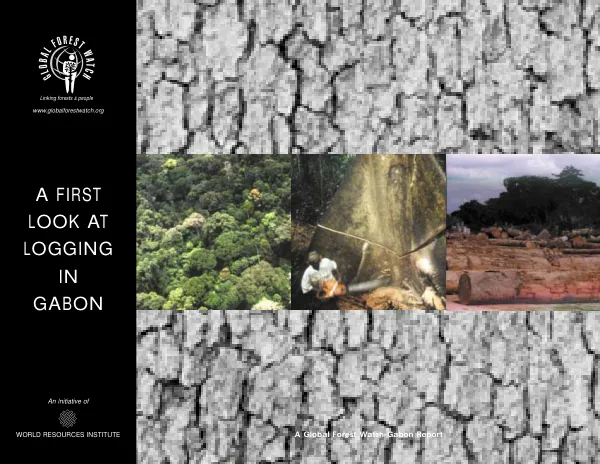
A first look at logging in Gabon
This document is the first civil society study to present complete, up-to-date, and peer-reviewed information on the logging industry in Gabon.
Collomb, Jean-Gael; Mikissa, Jean-Bruno · 1970
Sign in to readA free account is required to download.
Abstract
The first section gives an overview of logging activities within Gabon"s forests, using six indicators. These indicators show that logging has expanded rapidly from coastal areas to the country"s interior. Although at least two thirds of Gabon"s original forest cover is thought to remain, the actual extent of current forest cover is unknown (indicator 1). As of 1999, more than three quarters of Gabon"s forests have been, or currently are, allocated as logging concessions (logged, under logging development, or slated for logging) (indicator 2). As elsewhere in Central Africa, foreign interests exert significant control over the logging sector (indicator 3). Most of the rapid increase in logging development has taken place recently. For example, the area allocated to logging concessions has doubled In the past 5 years (indicator 4). Gabon"s wood production and export statistics (indicator 5) reveal that the industry lacks diversification, because it relies mostly on a single timber species (Okoume) and exports the majority of its logs to the Chinese and French markets. After extremely high levels of production in the 1990s, Gabon has suffered from the after- effects of the Asian economic crisis of 1997. Quotas were imposed on production levels as export volumes dropped by more than 50% in 1998. Finally, the logistical resources of the Ministry of Water and Forests (indicator 6) are unequal to the magnitude of the task to be achieved. Existing data are incomplete and sometimes of questionable accuracy, illustrating the disarray of forestry information and the challenges faced by the administration to properly manage this resource. The second section summarizes Gabon"s forestry law and tax system. The major problem with the forestry legislation is that it is weak and has been poorly implemented and enforced. Finally, the Gabonese government, NGOs, and some elements of the private sector have undertaken efforts to promote long-term management of forest resources. This report showcases the efforts of two government agencies (Institut National de Cartographie and Direction des Inventaires, de l"Amenagement, et de Regeneration des Forets [DIARF]) and one logging company (Compagnie Equatoriale des Bois) to promote better management of natural resources through the creation of new management tools and guidelines. Contains references and statistical charts for the six performance indicators. (Author abstract, modified)