USAID. DIRECTORATE FOR POLICY. CENTER FOR DEVELOPMENT INFORMATION AND EVALUATION (CDIE). OFC. OF EVALUATION
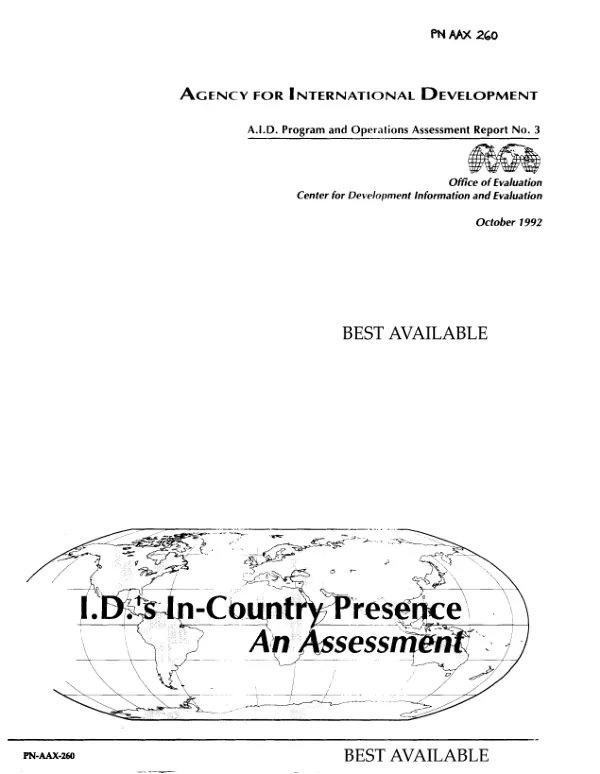
A.I.D.'s in-country presence : an assessment
A characteristic feature of A.I.D.'s foreign assistance program is the in-country presence of direct-hire A.I.D.
Koehring, John W.|Askin, Peter W. · 1992
Sign in to readA free account is required to download.
Abstract
personnel. This study examines the advantages and disadvantages of this in-country presence and identifies ways to make it more cost-effective. The study finds that A.I.D.'s traditional system of in-country presence provides two chief advantages: influence and program accountability. The system provides for the development of personal relationships between A.I.D. foreign service officers and host country counterparts and, in turn, allows program delivery to occur with a unique sensitivity to host countries' political and cultural atmosphere. Program accountability benefits from a higher quality of implementation, faster disbursement rates, and prompt decisionmaking. The study also found disadvantages with in-country presence, particularly a tendency toward a paternalistic approach that thwarts recipient governments' ability to handle their own affairs; excessive use of U.S. experts, even when qualified local experts are available; and over-bureaucratization of medium-sized and large Missions. However, the study concludes that A.I.D.'s in-country presence gives the United States a competitive edge in delivering economic and development assistance and should be retained as the cornerstone of A.I.D.'s operational mode. At the same time, there are several ways in which A.I.D. can maintain the benefits of in-country presence while reducing operating costs: by being more selective about the functions direct hires perform overseas, reducing documentation requirements, distinguishing more clearly between development and political programs, and making more concerted efforts to lead recipient countries to self-reliance. A series of action recommendations are presented in conclusion.
![Lessons learned : USAID/RCSA's [Regional Center for Southern Africa] experience in conducting a regional assistance program -- 1995-1997](https://covers.devme.ai/gen/5986.webp)
![Building constituencies for protected areas : matching grant FAO-A-00-97-00061-00 between the Nature Conservance [i.e. Conservancy] and USAID/PVC](https://covers.devme.ai/gen/61226.webp)
![Building constituencies for protected areas : matching grant FAO-A-00-97-00061-00 between the Nature Conservance [i.e. Conservancy] and USAID/PVC](https://covers.devme.ai/gen/5415.webp)