UNITED NATIONS
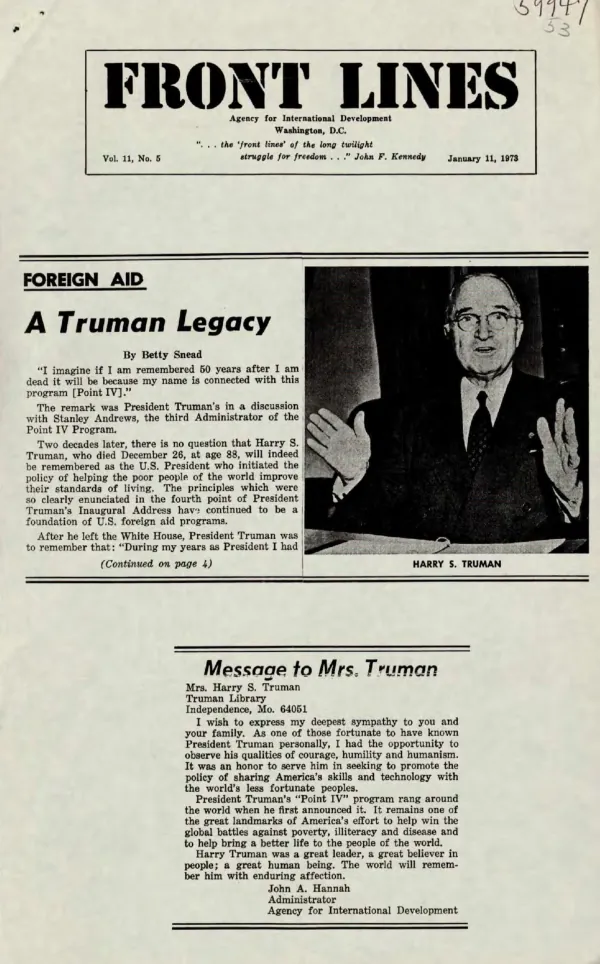
A Truman Legacy: FOREIGN AID
The Point IV program, initiated by President Harry S.
7 pages
Sign in to readA free account is required to download.
Abstract
Truman in 1949, aimed to provide technical assistance to underdeveloped countries to improve their standards of living. This program was a cornerstone of U.S. foreign aid policy, and its principles continue to influence international development efforts today. The idea for Point IV originated with Emmet John Hughes, an information officer with the State Department, who proposed the concept to President Truman's young administrative assistant, George Elsey. Elsey was attracted to the idea's uniqueness and potential, and he recommended it to Clark Clifford, a close advisor to President Truman. The President was enthusiastic about the idea, and it became the fourth point of his inaugural address. President Truman's vision for Point IV was to help the free peoples of the world, through their own efforts, to produce more food, more clothing, more materials for housing, and more mechanical power to lighten their burdens. He believed that only by helping the least fortunate of its members could the human family achieve a decent standard of living. This was a bold new approach to international development, as no other nation had ever committed itself to such a national objective out of dedication to bettering the world's chances for peace and prosperity. President Truman signed the Act for International Development on January 5, 1950, authorizing the Point IV program. The Korean conflict broke out 20 days later, and public attention shifted to the Far East. However, President Truman remained committed to Point IV, and he spoke about it many times, referring to it in his writings and numerous anecdotes. He was particularly interested in the Green Revolution in India and other successful examples of Point IV in action. The Marshall Plan, initiated and carried out during the Truman Administration, helped to revitalize Western Europe's economy and brought war-ravaged nations back to prosperity. Point IV was a natural extension of this effort, as it aimed to provide technical assistance to underdeveloped countries to improve their standards of living. President Truman's commitment to Point IV was a testament to his belief in the importance of international cooperation and his dedication to helping the world's most vulnerable populations. President Truman's vision for Point IV was not limited to economic development; it also encompassed social and cultural aspects. He believed that lasting freedom and independence could only be achieved among free nations if they possessed the means to maintain their free institutions and national integrity against aggressive movements. He saw poverty and discontent as the seeds of totalitarian regimes, and he believed that the United States had a responsibility to help underdeveloped countries overcome these challenges. In his inaugural address, President Truman emphasized the importance of cooperation and mutual understanding in achieving the goals of Point IV. He believed that the United States had a unique opportunity to share its skills and technology with the world's less fortunate peoples and to help them elevate their standards of living. This vision of international cooperation and mutual assistance remains a cornerstone of U.S. foreign aid policy to this day.
Related documents