USAID DEC
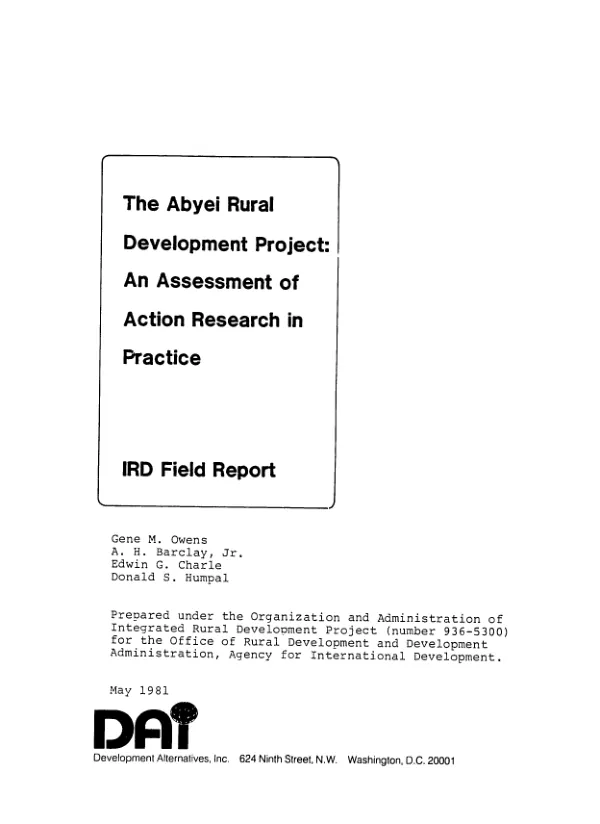
Abyei rural development project : an assessment of action research in practice; IRD field report
Sign inDEVELOPMENT ALTERNATIVES, INC. (DAI)
Abyei rural development project : an assessment of action research in practice; IRD field report
Evaluates project to develop a replicable integrated rural development (IRD) model in Abyei, Sudan.
Owens, Gene M.|Barclay, A. H., Jr. · 1981
Sign in to readA free account is required to download.
Abstract
Special evaluation, focusing on lessons generalizable to other IRD projects, covers the period 7/77-2/81 and summarizes and updates a 2/81 special evaluation (PD-AAH-698). This overambitious and ill-defined project, which largely failed in its effort to use action research to identify appropriate responses to development needs, offers several lessons for IRD management, design, implementation, and strategy. The failure of the project's management system to function well showed that: experimental projects require key operational decisions to be made by field staff; OPG's do not provide sufficient contractor accountability for experimental projects; and remotely located projects need extensive USAID field monitoring. Secondly, even project designs with flexible implementation plans must have specified structures and timetables; this project emphasized process at the expense of structure. The project also failed to reconnoiter the area thoroughly and it was inadequately funded. When addressing complex socio-technical problems, care must be taken to match financial and human resources to the scope of work. Project designers must also carefully weigh the timing and sequence of multiple components in IRD projects. Because the project included both research and benefit delivery functions, implementation was more complex than usual. The key problem is to find an appropriate balance between action and research. Contractors on action research projects must take full responsibility for providing implementation support and must include beneficiaries in the learning process from the outset. The project was signficantly weakened by its failure to foster participatory learning. The project's development strategy was atypical in that it targeted an area with high political visibility and complex socio-ethnic conflicts, it proposed (unsuccessfully) a local development organization with a degree of autonomy hitherto unknown in Sudan, and it was assigned national priority by the Sudanese Government. These elements suggest that: IRD projects should target politically unstable areas on a needs basis only; special status can make a project dependent on continuation of that status; and appropriate local organizations evolve, they are not prescribed.