USAID. MISSION TO PHILIPPINES
Accelerated agricultural production project
Summarizes interim evaluation (XD-ABB-029-A) of a project to accelerate agricultural production in the Philippines by strengthening: support services to farmers; agricultural marketing by the private sector; and agricultural policy and program formulation.
1990
Sign in to readA free account is required to download.
Abstract
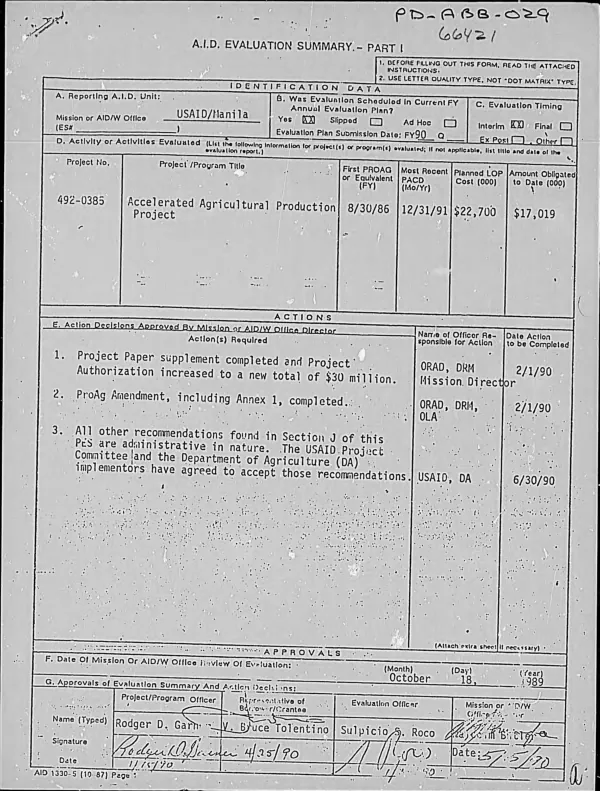
Evaluation covered the period 1986-9/89. The project has been implemented more slowly than expected, but the key constraints -- organizational and staff changes in the Department of Agriculture (DA), problems with the legal status of the National Irrigation Authority (NIA), and cumbersome Government of the Philippines (GOP) disbursement procedures -- have now largely been overcome. Relationships between A.I.D. and the DA and NIA have improved steadily and a spirit of collegiality has developed. Moreover, the instability stemming from the restructuring of the DA after the 1986 change of government has largely subsided, and new institutions and instruments to implement policies and programs are emerging. Basic procedures for such areas as financial reporting, farmer outreach, and statistical reporting have been developed and full- scale implementation is now underway. The processing time for dispersal of funds by the GOP for subproject activities has dropped from 140 calendar days in 1987 to 40 days in 1989. Disbursements in FY89 were three times those of FY87 and FY88 combined, and it appears that total planned expenditures will be reached prior to the PACD of 12/31/91. On the negative side, the project"s management system is outside DA"s normal command structure and hence demands an excessive amount of A.I.D. and DA management resources; it also contradicts the project"s institution-building nature and exposes it to the continued criticism that it is an A.I.D. rather than a GOP project. There is also a need to make the project"s monitoring and evaluation system a more effective tool for program management and for ensuring that activities reach the targeted beneficiaries. A strong policy formulation capability is critical for both participating GOP entities -- for the DA, where it is needed to fully operationalize the DA"s new management structure, and for the NIA, where implementation of policy changes is becoming an essential part of irrigation system management. It is thus recommended that the DA develop a 3-tiered policy analysis capability (an in-house rapid response capability, a semi- detached medium-term capability, and long-term policy research supported by outside contracts) and that the NIA establish a research and policy management cell. Finally, DA"s efforts to strengthen agricultural marketing, while critical to improve the flow of goods and services among producers, processors, and consumers, will founder until the DA develops a cohesive strategy that identifies its long-term role as that of a market manager and the private sector"s role as that of a market participant.
Related documents