USAID DEC
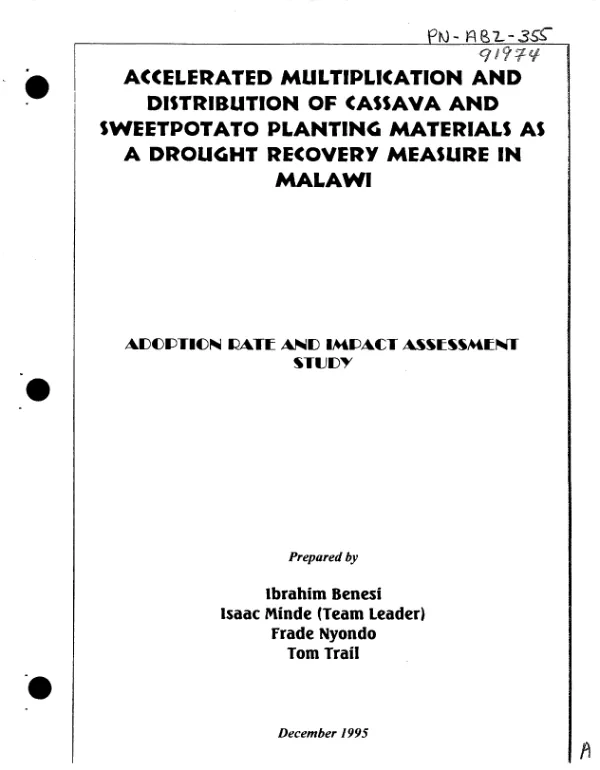
Accelerated multiplication and distribution of cassava and sweetpotato planting materials as a drought recovery measure in Malawi : adoption rate and impact assessment study
Sign inINTERNATIONAL INSTITUTE OF TROPICAL AGRICULTURE (IITA)
Accelerated multiplication and distribution of cassava and sweetpotato planting materials as a drought recovery measure in Malawi : adoption rate and impact assessment study
Assesses the impact of the Accelerated Multiplication of Cassava and Sweet Potato Planting Materials project, which was initiated in Malawi as a drought recovery measure.
Benesi, Ibrahim; Minde, Isaac · 1995
Sign in to readA free account is required to download.
Abstract
The assessment covers the period 1992-12/95 against a PACD of 3/96. The project has achieved and even surpassed its objectives. Coordination, training, technical backstopping, and the collaborative efforts of stakeholders all helped establish a foundation for a strong and effective multiplication and distribution system countrywide. A major contribution of the project was to influence a 1994 change in the Government of Malawi"s agricultural policy to support crop diversification with emphasis on cassava and sweet potato as drought-tolerant crops, thereby reversing the previous administration"s heavy promotion of maize and 30-year neglect of cassava and sweet potato. The 1995 estimate for cassava hectarage (95,000 ha) represented a 31% increase from the previous year, and sweet potato hectarage more than doubled to 61,000 ha, a 63% increase. Farmers estimated that the new cassava varieties yielded 100-200% more than traditional varieties and new sweet potato varieties increased yields by 200-300%. Economic studies comparing cassava and sweet potato with maize, tobacco, cotton, and rice over the past 3-year period indicate that farmers can realize four to five times greater net profit per ha with the project crops. Farmers also reported reduction of the length of the yearly hunger period when the food supply is severely reduced and expensive, and attribute this to the greater supply of cassava and sweet potato. The consumption of the leaves of the crops adds needed nutrients to the rural diet, especially when food is scarce. One of the unexpected results of the project has been the rapid increase in the commercial sales of cassava and sweet potato from rural to urban areas. Over 20% of the amount produced is now marketed and the proportion is rising. This extra income is utilized to purchase other food, medicine, and fertilizer for maize, and pay school fees. Linkages were established among several groups of stakeholders: research stations and staff, eight Agricultural Development Divisions, 12 NGOs, many church groups, International Institute of Tropical Agriculture/Southern Africa Root Crops Research Network (IITA/SARRNET), donors, and farmers. Several innovative multiplier volunteer contact farmer programs were developed by NGOs, and an NGO produced the first fact sheets on cassava in the local language. Additional funding and training will help the NGOs continue to establish secondary nurseries, distribute planting materials, and monitor and advise farmers. (Author abstract)
Related documents
Documents in this collection
 1993
1993USAID DEC
AID grant no. 690-0270-G-00-3055-00 to International Institute of Tropical Agriculture to accelerate multiplication and distribution of improved cassava and sweet potato planting material as a drought recovery measure in Malawi
Open record 2001
2001USAID DEC