USAID. MISSION TO EGYPT
Activity assistance completion report : decentralization support fund
PACR of the Decentralization Support Fund (DSF), designed to accelerate administrative decentralization in Egypt by providing 21 rural governorates with money to procure U.S.
1992
Sign in to readA free account is required to download.
Abstract
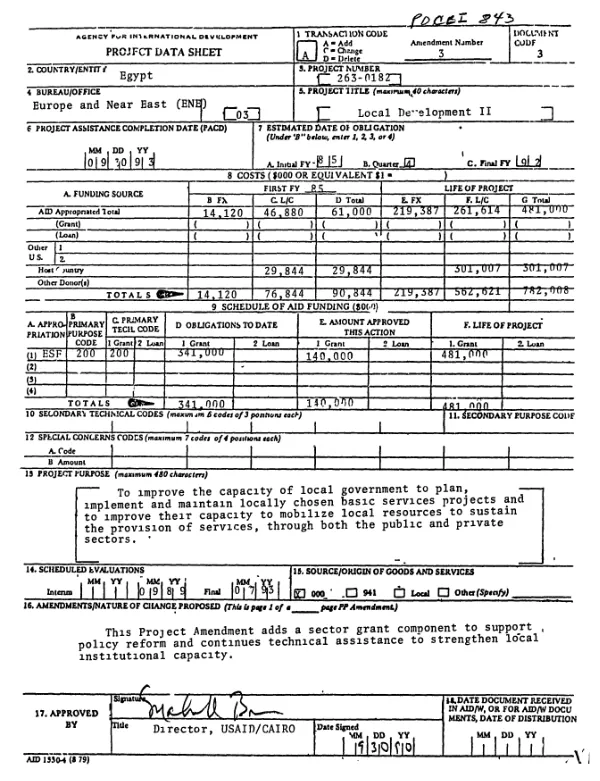
capital and other equipment. The DSF was initiated in 1980 as project 2630143, subsequently subsumed as subproject 04 under 263K605, and was completed under 2630161.04; a follow-on, Local Development II (LD II - 2630182) has been active since 1985. Report covers the period 9/80-9/91. Capital equipment supplied under DSF greatly increased the capacity of the 21 participating governorates to provide basic services to their rural populations, and especially to improve environmental conditions. USAID disbursements for DSF of almost $100 million enabled purchases of 1,776 major pieces of equipment, service vehicles, and associated spare parts, as well as smaller items such as pumps and laboratory equipment. DSF equipment is now providing enhanced fire protection, improved sanitation trough wastewater pump trucks and garbage trucks, expanded supplies of potable water, and other new/improved services in rural cities, markaz, and villages. The experience gained by local and central government entities through planning and procurement activities (e.g., preparing technical specifications, contracting for offshore procurement) also enhanced institutional capacity to deliver basic services and strengthened the decentralization process. Inventory and control systems for spare parts, as well as operation and maintenance procedures, have been established and institutionalized under DSF and LD II at governorate and markaz levels. While equipment utilization and availability rates are generally satisfactory, there were some exceptions. South Sinai, Red Sea, and New Valley have average utilization rates of 40%, 58%, and 51%, respectively, and availability rates of 76%, 74%, and 79%; however, these relatively low numbers can be explained in part by the isolation of these governorates from service/repair facilities, as well as the fact that most equipment is used for seasonal purposes. Utilization rates in Fayoum and Qalubia, at 54% and 45%, are unsatisfactory, as is Fayoum's availability rate of 68%. Low rates are indicative of poor maintenance management, leading to excessive work days spent on repair. LD II is addressing maintenance management in problem governorates. The following lessons were learned. (1) Equipment assistance programs must be critically evaluated and corrected early in the implementation stage. (2) There was a general lack of awareness at all levels of the importance and benefits of adequate operation and maintenance of equipment, as well as a lack of maintenance resources (tools, facilities, and especially trained staff); LD II is emphasizing these aspects. (3) Monitoring under LD II has revealed that some items provided under DSF were severely underutilized, primarily refrigerator trucks, small asphaltic batch plants, and solid waste incinerators; the need for such unusual items should have been more thoroughly assessed.
Related documents