USAID DEC
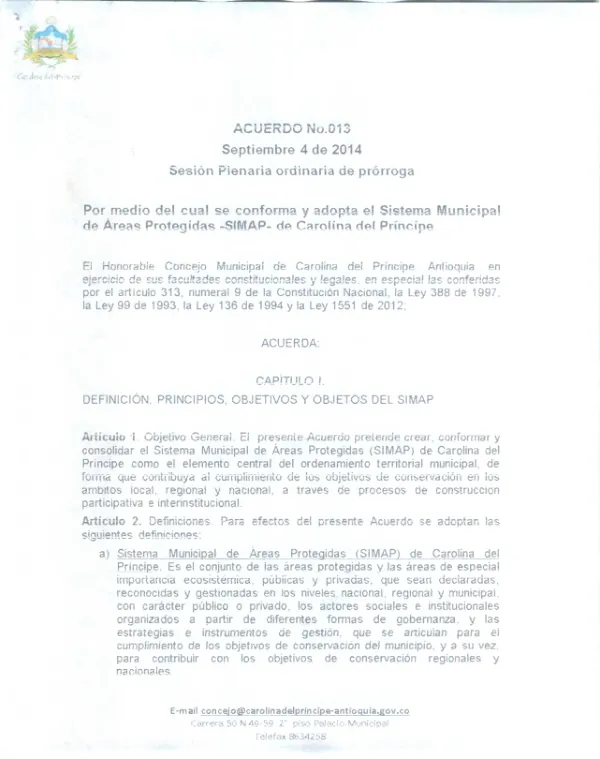
Acuerdo de Creación y Conformación del Sistema Municipal de Áreas Protegidas (SIMAP) de Carolina del Príncipe
Sign inUSAID DEC
Acuerdo de Creación y Conformación del Sistema Municipal de Áreas Protegidas (SIMAP) de Carolina del Príncipe
The Sistema Municipal de Áreas Protegidas (SIMAP) of Carolina del Príncipe was established through an agreement that aimed to create, conform, and consolidate the SIMAP as the central element of the municipal territorial order.
2014 · 26 pages
Sign in to readA free account is required to download.
Abstract
This agreement was adopted on September 4, 2014, and was based on the principles of the Constitution of Colombia, the Law 388 of 1997, the Law 99 of 1993, the Law 136 of 1994, and the Law 1551 of 2012. The SIMAP is defined as the set of protected areas and areas of special ecological importance, public and private, that are declared, recognized, and managed at the national, regional, and municipal levels, with public or private ownership. The SIMAP includes areas protected by law, areas of conservation and environmental protection, and areas of special ecological importance. The SIMAP is guided by six principles: the articulation between the SIMAP and the municipal territorial order, the management of SIMAP areas, the adaptive management of SIMAP, the participation of social actors, the conservation of private lands, and the consolidation of public-private alliances. The SIMAP has six specific conservation objectives, which are aligned with the objectives of the Sistema Nacional de Áreas Protegidas (SINAP) and the Sistema de Áreas Protegidas de Antioquia (SIPAA). These objectives include the recovery and maintenance of humid premontane and montane forests, the recovery and maintenance of natural ecological and evolutionary processes, the restoration and conservation of ecosystems that ensure water supply and regulation, the promotion of agricultural and livestock areas for soil protection and ecosystem connectivity, the preservation and promotion of scenic areas and elements, and the increase of social and territorial adaptability. The SIMAP also identifies six conservation objects, which are the Puma (Puma concolor), the jaguar (Panthera onca), the Andean condor (Vultur gryphus), the spectacled bear (Tremarctos ornatus), the harpy eagle (Harpia harpyja), and the Andean cock-of-the-rock (Rupicola peruvianus). The conservation of these species will be achieved through the implementation of connectivity corridors between large forest and páramo patches, which will favor the extension of their habitat and the presence of their prey. The SIMAP also aims to promote the conservation of private lands and the connection of fragmented ecosystems through the implementation of agricultural and livestock practices that protect soils and promote ecosystem connectivity. Additionally, the SIMAP will promote the consolidation of public-private alliances to favor the conservation of natural resources and the provision of ecosystem services. The SIMAP is a key instrument for the conservation of biodiversity and the provision of ecosystem services in the municipality of Carolina del Príncipe. Its implementation will require the participation of various social actors, including the municipal government, the private sector, and civil society, as well as the development of strategies and instruments for the management and conservation of protected areas and ecosystems.