USAID DEC
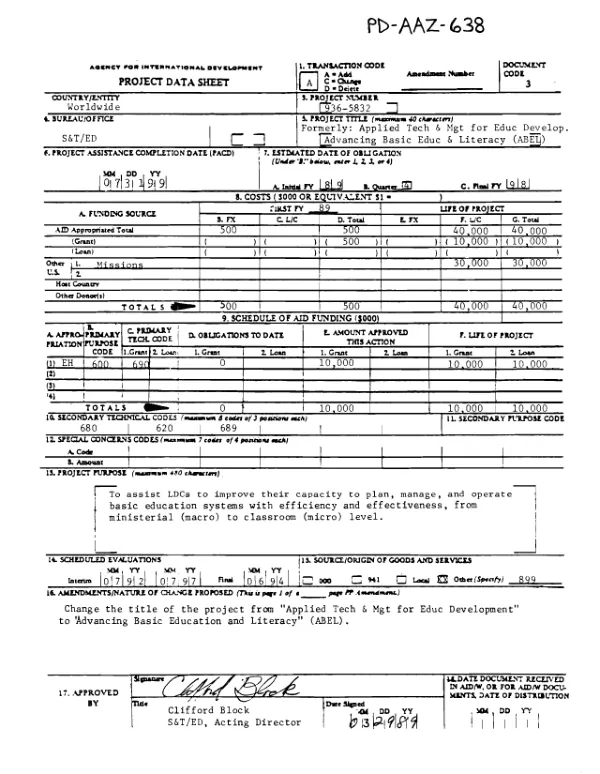
Advancing basic education and literacy [ABEL] project -- project no. 936-5832 : external evaluation
Sign inMANAGEMENT SYSTEMS INTERNATIONAL, INC. (MSI)
Advancing basic education and literacy [ABEL] project -- project no. 936-5832 : external evaluation
Evaluates project to improve basic educational systems in developing countries, with an emphasis on gender issues and productivity (ABEL project).
Schumacher, Henry A.|Gonzalez, Digna Diana|Wilder, Bernard D. · 1995
Sign in to readA free account is required to download.
![Advancing basic education and literacy [ABEL] project -- project no. 936-5832 : external evaluation](https://covers.devme.ai/gen/7231.webp)
Abstract
Interim evaluation covers the period 1989-94. Of $13.9 million expended so far, $8.8 million (60%) has come from buy-ins, with 95% of buy-ins coming from Africa and 76% from Mali and South Africa. To date, the project has: (1) researched and written educational sector assessments in Malawi, Paraguay, Ghana, Uganda, and Ethiopia; (2) published and disseminated 12 issues of FORUM, 41 issues of the ABEL Information Bulletin, two major research studies (on the economic and social impact of girls education and strategies for increasing their access and achievement in school), a case study from Bangladesh's experience with primary education, and a handbook guiding policy makers in improving educational testing; (3) designed a family of educational policy modules and disseminated them in South Africa, Malawi, Botswana, Namibia, Bolivia, Chile, Guatemala, and Paraguay; (4) maintained a database on women's education (SARA) at Creative Associates International and another on developmental education (SHARE) at Harvard Institute for International Development; (5) conducted workshops and conferences for professional educators in policy dialogue and modeling using the new group of education modules; (6) responded quickly and appropriately to USAID Mission requests for TA in 13 countries and established field offices in South Africa and Mali; and (7) initiated South African policy dialogues on educational options using computerized simulation tools developed by Research Triangle Institute. Overall, the project has been successful in responding to USAID Mission and USAID/W requests and its support to other USAID projects, grantees (NGOs), ministries of education, and educational institutions has been well received. The Women in Development (WID) buy-in was matched with other core or Mission buy-ins and was probably the best investment. Dissemination of useful lessons learned and research on gender issues added value to advancing basic education worldwide, though more effort is needed to assure that publications, tools, and research results get into the hands of Mission Human Resource Development Officers and target audiences. Training programs in South Africa and Mali have had an impact on strengthening educational institutions and schools. The managerial support from both USAID and the prime contractor allowed the subcontractors and their consultants to perform their roles in a professional manner. Financial management improved over time, but never was able to clearly account for Mission and WID buy-ins related to specific activities of both the prime and subcontractors. Also, USAID's financial management system for buy-ins is not sufficient to allow for the field missions to monitor their expenditures. Ceilings on buy-ins prevent Missions from using them in creative ways to augment their needs. Lessons learned were as follows. (1) The synergy that develops among different groups of stakeholders through use of common tasks will enhance institutional change. (2) Micro-level planning is a key element in having an impact on schoolchildren at the local level. (3) Policy dialogue is key in maximizing the cooperation among government agencies. Other donors' efforts, working within a democratic environment, must be included so that the audience is broadened to effect change. (4) When cultural sensitivities are taken into account, WID activities that are integrated into the educational system will become more sustainable. (5) Since ABEL depends on Mission buy-ins for funding, the logframe for the project should cover only core activities, although buy-ins which are for significant amounts of resources could benefit from developing a logical framework as they are conceived. (6) Buy-ins allow missions to obtain consultancies and TA relatively easily without implementation delays caused by an extended bidding process. (7) The financial management system is an important tool in monitoring Mission buy-ins and contributes to sound management. (8) A monitoring and evaluation function in a global project is important in understanding the relationships between investment and impact on target audiences. (9) Sending large numbers of publications does not guarantee the most impact on target audiences. Greater attention must be given to the distribution systems. (10) Letting a project like ABEL become very heavily involved in a limited number of countries severely limits its ability to reach a larger target audience worldwide. (Author abstract, modified)