USAID. MISSION TO PAKISTAN. OFC. OF THE AID REPRESENTATIVE FOR AFGHANISTAN AFFAIRS
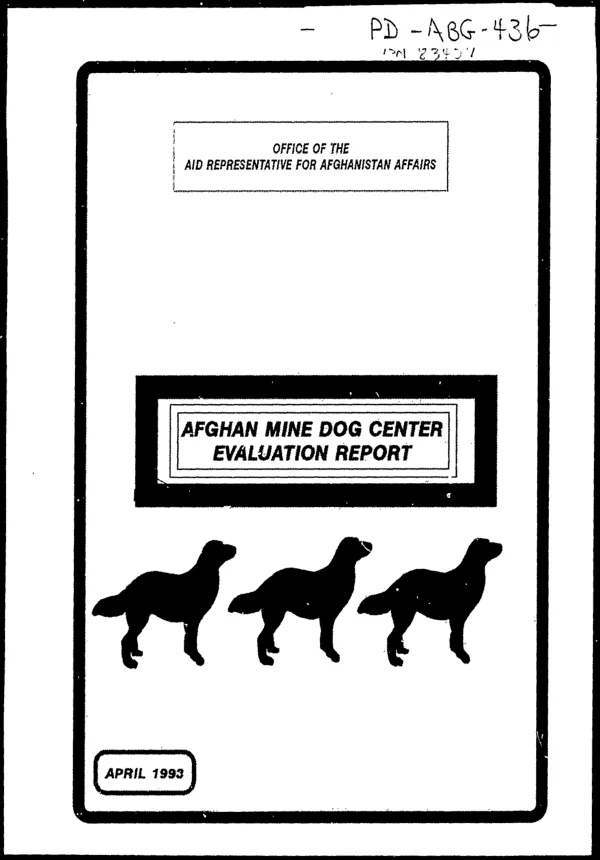
Afghan Mine Dog Center : evaluation report
The United Nations estimates that nine to ten million mines are scattered throughout populated areas of Afghanistan where they endanger lives, threaten injury, and disrupt repatriation and economic development.
1993
Sign in to readA free account is required to download.
Abstract
Since June 1989, A.I.D has contributed to donor efforts to clear primary transportation routes, agricultural areas, and population centers of mines. It has done so through support of the Mine Dog Center (MDC), a collective term which refers to facilities that provide administrative, technical, and logistic support for the maintenance, training, and deployment of up to 100 dogs and their handlers. The MDC includes a main facility, located in Pabbi near Peshawar in the Northwest Frontier Province, serving northeastern Afghanistan; and a smaller facility in Quetta, which serves southern Afghanistan. In Risalpur (for Pabbi) training is provided by the Pakistan Army. Training facilities near Baleli Camp (for Quetta) are leased from a private land owner. Although funded and managed through an A.I.D. contractor, the Center operates in conjunction with Afghan demining NGOs under the United Nations Office for the Coordination of Humanitarian Assistance to Afghanistan (UNOCHA) Mine Clearance Programme (initiated in 1989). MCD teams of dogs, handlers, and leaders/paravets are deployed on an as needed/as available basis. The MDC dogs, specially bred German Shepherds and Belgian Malinois with a sense of smell far more sensitive than that of humans, are trained to detect the scent of explosives underneath layers of earth, on roads, in mine fields, and in buildings where there is little ground cover or rubble. The dogs are capable of detecting anti-personnel, anti-tank, metal, plastic, or rubber mines as well as trip wires and booby traps. They signal the whereabouts of explosives by assuming a sitting position. MDC teams spend an average of two months working from regional sites inside Afghanistan and then are brought back to the MDC for one-month refresher training. In spite of apparent religious and cultural biases against dogs, Afghan handlers have formed strong bonds with their animals. Evaluation results are as follows. (1) Integration of the MDC dogs with Afghan survey and demining teams has proven to be highly successful; they have reduced the risk of death and injury to humans and expedited survey and mine-clearance activities. (2) Funding and logistical support have been sufficient to operate the MDC at full capacity. (3) Staff are highly trained and have exhibited a high performance level. Management staff have good relationships with other NGO staff and UNOCHA"s regional offices. (4) Dogs are well cared for and well trained. Deployment, though informal, appears to keep dog teams busy and has satisfied current demining requirements. (5) Operating procedures and record-keeping have met A.I.D. and UNOCHA requirements. (6) Internal integration of administrative, logistics, and technical operations appears good. Lessons learned include the following. (1) UNOCHA"s Mine Clearance Programme represents an organized effort by the United Nations to address the devastating effect mines have on post-war resumption of social and commercial activity in Afghanistan. (2) MDC participation in this effort is a meaningful contribution which could not be duplicated if there was no interaction between UNOCHA and the MDC. It is recommended that both organizations maintain, at a minimum, the current level of MDC demining operations. Although, at this point, neither the MDC nor UNOCHA are fully prepared for transfer of the MDC to UNOCHA"s umbrella Programme on June 30, 1993. (Author abstract, modified)