CREATIVE ASSOCIATES INTERNATIONAL, INC. (CAII)
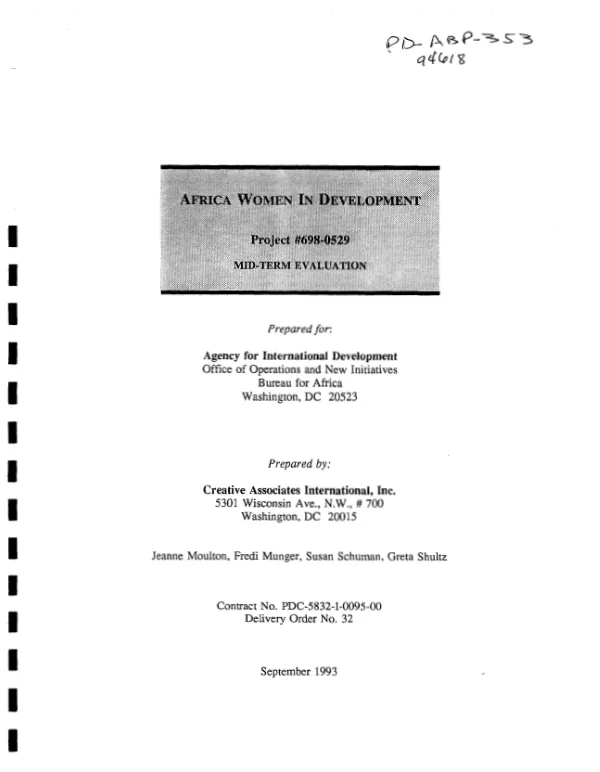
Africa women in development, project 698-0529 : mid-term evaluation
Evaluates project to bring women in development (WID) concerns into the mainstream of programs and operations in Africa, mainly by placing Africa Bureau- and WID Office-supported advisors in regional offices in East, West, and southern Africa (AFWID project).
Moulton, Jeanne|Munger, Fredi · 1993
Sign in to readA free account is required to download.
Abstract
Interim evaluation covers the period 1989-9/93. The project has demonstrated the value of using regional advisors to give TA to USAID missions in developing the gender dimensions of their programs and projects, and has forged links between local women's groups and USAID mission programs. However, there were many design and flaws that thwarted implementation. For example, those mission staff who were aware of, and presumably interested in, the project during its planning stages had been replaced by 1991 when the project was launched. As a result, many of the missions were either unaware of or uninterested in the project's services creating a tense working environment. The project's strategy -- to focus resources on selected countries in each region -- aggravated the situation; some focus countries resisted AFWID's involvement in their mission, while other non-focus countries, which were interested in AFWID services, were not provided them. Moreover, the advisors' job was difficult; they had a mandate which covered almost every aspect of the mission's program and had to operate within a complicated structure in which they were coordinated by the resident advisor in Washington, D.C., supervised by the regional office in Africa, and accountable to the funding WID office. The resident advisor in Washington was hired by a local contractor (who was responsible for administering Washington-operations funds), but reported directly to the USAID project manager. Finally, a 1991 reorganization of the Africa Bureau forced a separation between the Bureau's project management, which came from the Office of New Initiatives (ONI), and its leadership and policy guidance, which came from the Development Planning (DP) division. These structural flaws resulted in a breakdown not only of the executive (leadership) system, but also of operations, financial management, and information management. Quality control by the regional offices has varied from one to the next; REDO/ESA has supported the regional advisor, REDO/WCA and the mission in Botswana have not. Other project constraints involved a high turnover in the project manager position, a financial data system that was not a good resource for information, and the fact that the project neither developed a gender information system, the intended cornerstone of the project, nor provided the short-term TA to regional advisors or missions as planned. Finally, there were disruptions within the WID office, a lack of attention from the administration in Washington to WID and gender concerns, and generally weak incentives for either bureau or mission staff to devote time to these concerns. In sum, despite some achievements, AFWID has not proven an effective means of institutionalizing WID and gender concerns within the region, although some of the functions introduced by the project -- advisors in the regions and technical and policy/advocacy assistance within the Africa bureau -- have been valuable and should be continued. The overall recommendation is that the Africa bureau phase out the AFWID project but not discontinue its support of WID activities, particularly regional advisors.