USAID DEC
African child survival initiative : combatting childhood communicable diseases (regional components)
Sign inUSAID. BUR. FOR AFRICA. OFC. OF TECHNICAL RESOURCES
African child survival initiative : combatting childhood communicable diseases (regional components)
Summarizes external final evaluation (XD-ABD-534-A) of the core support components of a regional project to improve child survival in Africa through increased immunization coverage and control of malarial and diarrheal diseases.
1991
Sign in to readA free account is required to download.
Abstract
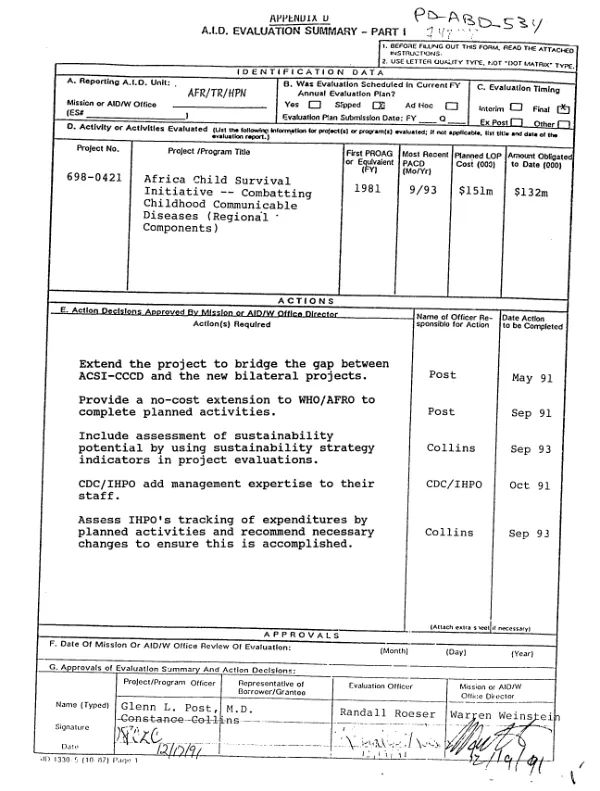
Final evaluation covers the period 1981/11/90. Major findings are as follows. (1) In project countries, immunizations increased and morbidity from vaccine preventable disease declined (up to 75% for polio in 3 countries), use of oral rehydration therapy and salts increased, ministries established policies for malaria prophylaxis and treatment, and research induced other important policy changes. (2) The core has provided valuable TA, training, and backstopping support for in-country activities, especially in the three target interventions. Achievements include nearly 100 applied research studies, training of more than 900 persons, development of health education programs, installation of computerized health information systems in central ministries, training and assistance in applied research, and consultative conferences. (3) Adoption of a country-specific and medical/technical approach limited the project"s potential to conduct cross-national research and exercise leadership beyond technical issues. (4) While the project"s focus on selected vertical interventions helped develop programs, it constrained the development of integrated, sustainable institutions. (5) Management oversight by A.I.D./W was weak during the first half of the project, and the project"s complexity created confusion about the respective responsibilities of A.I.D./W, the Centers for Disease Control, and USAID"s. (6) The addition of a sustainability strategy during the project"s seventh year did not cause the hoped for re- deployment of activities and resources towards institution building and organizational development; further efforts are needed in these areas. (7) Despite the project"s success in helping countries develop health services, more donor assistance is needed, especially in developing in-country administrative and fiscal infrastructure. (8) Management information systems are underdeveloped relative to the health/epidemiological information systems. Several lessons were learned. (1) Regional projects have four distinct advantages: they allow A.I.D./W to exert influence over USAID"s in choosing and adopting subject areas and innovations; permit easy exchange of ideas, programs, innovations, and research results across national boundaries; promote efficiencies of scale; and allow A.I.D./W to support small countries without bilateral projects and to fund activities that benefit several countries (e.g., regional training). An effort should be made to maintain these benefits as regional projects are replaced by bilateral projects. (2) For projects of this scope, smaller evaluations of specific components may be more manageable and useful than overall evaluations. (3) A.I.D./W needs to stress project management more, especially contract and financial management. The Mission notes that the evaluation, while comprehensive, is excessively lengthy and has certain defects. For example, the project did not set out to promote institutional change and so cannot in fairness be criticized for failing to do so. Africa Bureau health staff feel that while a shift toward institutional/managerial development is warranted, technical issues continue to require major attention, especially in the areas of family planning, AIDS and other sexually transmitted diseases, and acute respiratory infections. A key action decision is to extend the project in order to bridge the gap between this and the new bilateral projects.
Related documents
![Final evaluation : child survival project in Semuto and Butuntumula, Luwero District - Uganda -- AMREF [African Medical and Research Foundation, Inc.] Uganda project -- project period Oct, 1992 - Sep, 1995](https://covers.devme.ai/gen/85661.webp)