USAID. BUR. FOR AFRICA. OFC. OF TECHNICAL RESOURCES
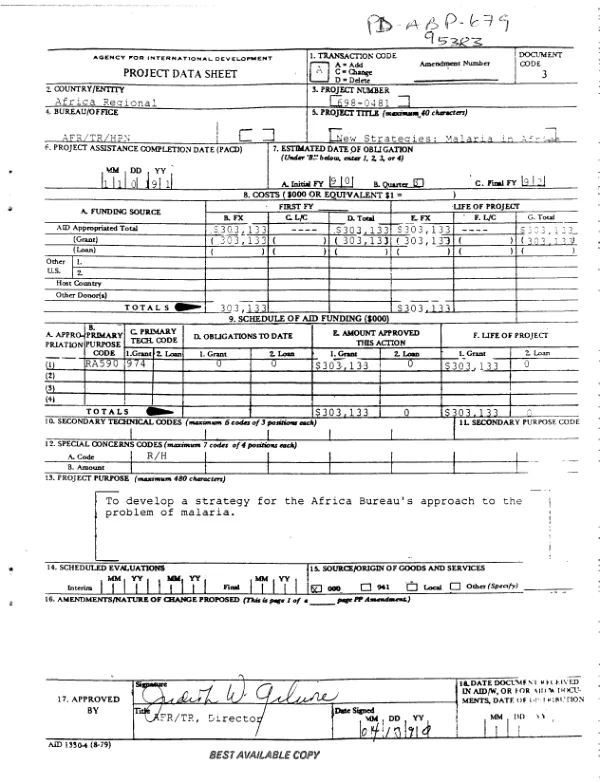
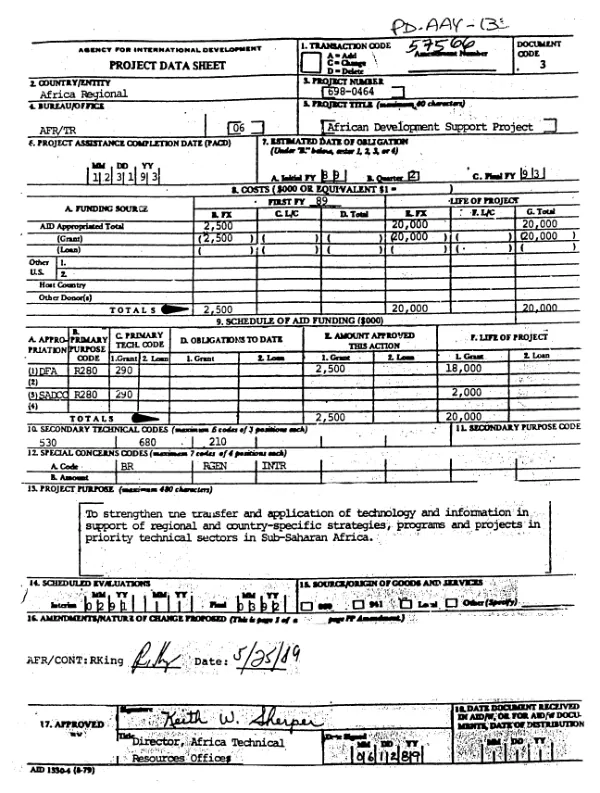
African development support project
Project to provide the Africa Bureau, REDSO"s, and field Missions in sub-Saharan Africa with improved access to the technical expertise and information needed to support effective strategies, programs, and projects.
1989
Sign in to readA free account is required to download.
Abstract
The Africa Bureau"s Office of Technical Resources (AFR/TR) will the primary implementing agency. The project will provide technical support at three levels. (1) REDSO"s and field Missions will receive 89 person-years of specialized long-term TA in such areas as women in development, the environment, engineering, food security, pesticides, forestry, energy, and behavioral science. (2) AFR/TR"s three technical divisions -- Agriculture and Natural Resources (ANR), Health, Population and Nutrition (HPN), and Education and Human Resources (EHR) -- will receive 25 person-years of long-term TA to address specific, high-priority, technical needs. It is expected this will include long-term advisors in agricultural policy analysis, agricultural development strategies, land tenure, agricultural economics, and communications (for AFR/TR/ANR), in education economics and in information (for AFR/TR/EHR), and in health economics (for AFR/TR/HPN). (3) AFR/TR will establish a core technical group, comprised of direct-hire personnel supported by short-term TA, to (a) undertake studies of cross-sectoral and regional issues, disseminate study results, hold conferences, etc; and (b) set up a system for improved information flows among A.I.D./W, REDSO"s, Missions, and host-country agencies. Technical services under these three components will be targeted at a broad range of priority sectors and regions. Expected outputs include the following: (1) 6 analyses of regional and subregional themes, e.g., agricultural policy reform efforts, regional agricultural research, and comparative health care programs; (2) 4 cross-cutting technical analyses of such issues as food security, P.L. 480 disincentives, land tenure reform, etc.; (3) 45 country-specific sectoral analyses and/or strategies; (4) 15 seminars and workshops (country-specific or regional); and (5) 65 project-specific feasibility studies and/or evaluations.
Related documents