JEFFALYN JOHNSON AND ASSOCIATES, INC.
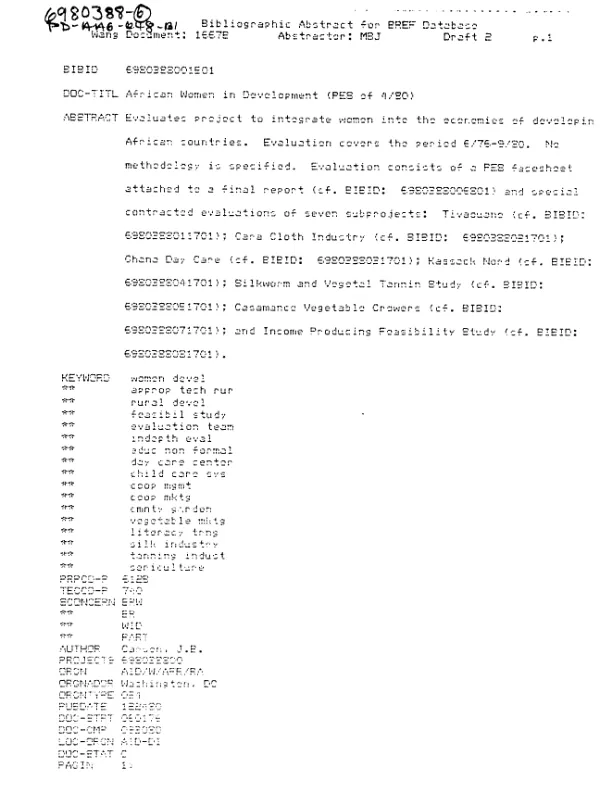
African women in development
While the design and implementation of women in development (WID) projects are flawed, these innovative projects do conform to A.I.D.
1970
Sign in to readA free account is required to download.
Abstract
mandates and with modifications are replicable. So concludes this study of seven small-scale WID projects involving vegetable production and women"s workload in Senegal, day care in Ghana, the cloth industry in Sierra Leone, and studies of the vegetable tannin and silkworm industries and of the role of women in Upper Volta. Regarding the projects" designs, in many cases outputs were not quantified, goals and purposes were unrealistic, feasibility studies (when conducted) were ignored, baseline data were inadequate, and input from the target population was insufficient. Implementation was often marred by the inadequate, inappropriate, or untimely arrival of inputs; by a shortage of project management skills; and by spotty participant involvement and host government support. As a result, patterns of achievement were inconsistent. Significantly, there is no evidence that the projects altered the traditional attitudes of local men. External problems common to all the projects included drought, illiteracy, and weak national economies. The author recommends that WID projects requested by potential beneficiaries to meet a specific need be adequately developed and funded, but that multi-sector WID projects be integrated into larger rural development programs. Further, WID project designs should: include feasibility studies of the project"s impact and realistic outputs, purposes, and goals; be allotted adequate time and money; and contain plans for interim and final evaluations. Effective implementation necessitates delivery of needed inputs; monitoring of outputs, external factors, and potential problems; involving beneficiaries (including men) in project operations; and soliciting the support of host governments. Finally, evaluators should use both quantifiable and soft (subjective) data and should be allowed sufficient time for their task. Appended are separate evaluations of the seven projects.
Related documents