USAID DEC
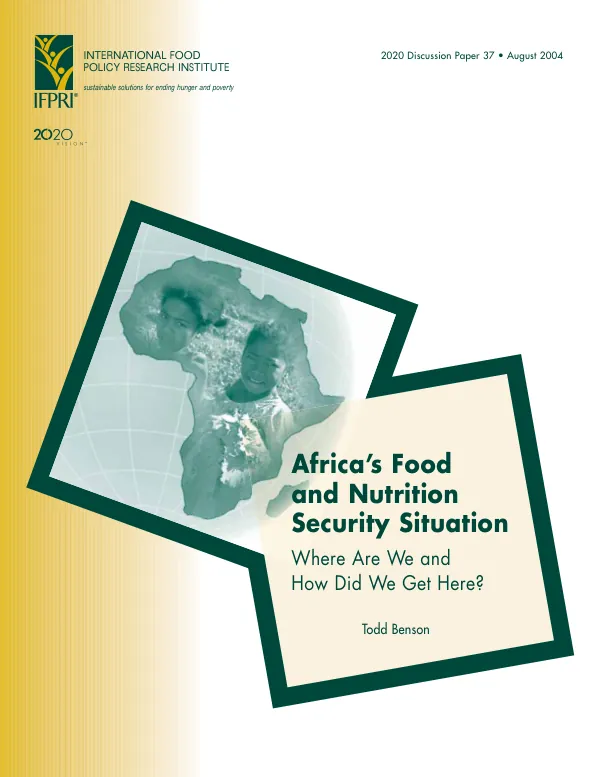
Africa"s food and nutrition security situation : where are we and how did we get here?
Sign inINTERNATIONAL FOOD POLICY RESEARCH INSTITUTE (IFPRI)
Africa"s food and nutrition security situation : where are we and how did we get here?
Food and nutrition security remain Africa"s most fundamental challenges for human welfare and for economic growth.
Benson, Todd · 2004
Sign in to readA free account is required to download.
Abstract
Whereas the prevalence of malnutrition globally is 14%, it reaches 27.4% in Africa as a whole and just under 33% in sub-Saharan African. Recent estimates are that undernutrition is the major risk factor underlying more than 28% percent of all deaths in Africa (some 2.9 million annually). This paper aims to provide a reasonably comprehensive assessment of the multiple facets of food and nutrition security in Africa. Chapter 2 defines food and nutrition security more closely and contrasts the two terms "food security" and "nutrition security." It also identifies the key conceptual determinants of food and nutrition insecurity in Africa and discusses key indicators for the measurement thereof. In particular, by coupling consideration of a hygienic environment, adequate health services, and knowledgeable care with existing understanding of food security, a broader concept of nutrition security and a better practical understanding of why so many Africans are not adequately nourished is developed. Chapter 3 builds on this discussion to provide an overview of the levels of and trends in food and nutrition security across the continent. The data are presented from a range of different perspectives -- food production and consumption, calorie and micronutrient availability, health and care. A broad analysis identifies where significant progress in reducing food and nutrition insecurity has occurred, as well as where significant backsliding is taking place. As data allow, the current dimensions of food and nutrition insecurity in Africa are assessed to provide a clearer understanding of how many are affected, where they live, and who they are. Chapter 4 provides a conceptual framework for action and examines a broad range of driving forces, operating from the individual and household to the regional and international scales, that have shaped recent trends and will continue to be important in the future. Here the conceptual overview and empirical evidence of chapters 2 and 3 are brought together in an assessment of how effective action may be taken to address the causes of malnutrition and food insecurity in order to effectively and sustainably eliminate them. Chapter 4 also gives considerable attention to the actions that the various sectors of government and the economy can contribute to this effort. The final chapter places this assessment within the frameworks for action presented by initiatives to address poverty and food and nutrition insecurity in Africa, e.g., the New Partnership for Africa"s Development (NEPAD). Special attention is paid to financing, the paper arguing that African governments themselves should take the lead in making the necessary investments to assure the food and nutrition needs of their citizens.
![IFPRI"s [International Food Policy Research Institute"s] strategy twoard food and nutrition security : food policy research, capacity strengthening, and policy communication](https://covers.devme.ai/gen/35866.webp)