CHECCHI AND CO. CONSULTING, INC. (CCCI)
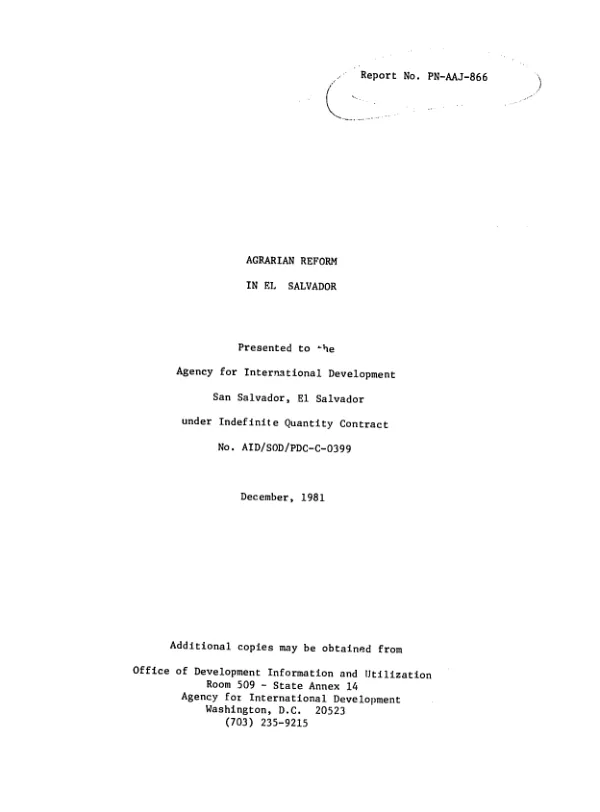
Agrarian reform in El Salvador
El Salvador cannot achieve an equitable land distribution without reorganizing the land-holding pattern, creating greater income equity, and increasing rural employment and agricultural production.
Paarlberg, Don; Cody, Peter M. +1 more · 1970
Sign in to readA free account is required to download.
Abstract
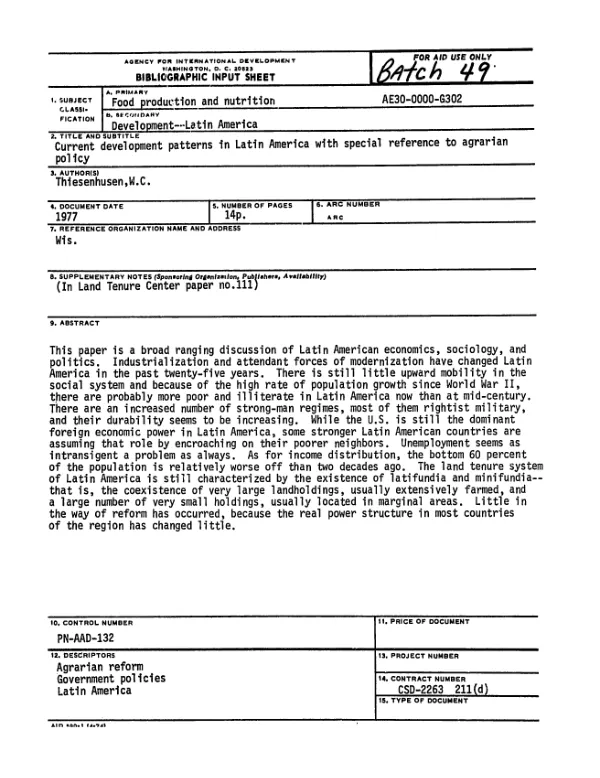
This study analyzes the Government of El Salvador"s (GOES) attempt to achieve these ends through a three-phase agrarian reform implemented by the Salvadoran Institute of Agrarian Transformation (ISTA). Phase I of the reform expropriates estates in excess of 500 ha (compensation is determined by declared land value on 1976-77 tax returns) and redistributes this land to cooperative agricultural associations. Between 3/80 and 10/81, 326 such farms (223,806 ha or 12.1% of total national farm land) were "intervened" and are now co-managed by ISTA and the cooperatives with GOES army enforcement, where necessary. ISTA is to provide technicians, promotors, and legal and auditing services to the cooperatives, but financial constraints, lack of coordination, and a shortage of trained manpower are complicating this process. Nevertheless, yields on Phase I farms are being maintained and employment, income, and land ownership are increasing. Phase II, the redistribution of estates between 100-500 ha (343,000 ha or 18.5% of total farm land), and Phase III, the conversion of land under 100 ha (expected to affect 178,000 ha) which is rented or tilled by someone other than the owner into plots of up to 7 ha, are not being implemented. Activation of Phase II has been indefinitely delayed due to financial and managerial burdens on the GOES, the opposition of politically powerful owners of Phase II farms, and the high level of violence in rural areas. No compensation or legal titles have been provided under Phase III, in part due to legal and administrative difficulties and questionable GOES commitment. Finally, full realization of the reform, a process the GOES considers irreversible, is threatened by the high level of violence in the country; the rhetoric and myths surrounding reform from all political factions; the reform"s inability to solve all the problems of the rural poor, especially the landless; and the administrative burden and budgetary cost to the GOES. A 60-item (1971-81) list of references, case studies, and specific recommendations for A.I.D. support of the reform are included.