USAID. MISSION TO INDONESIA
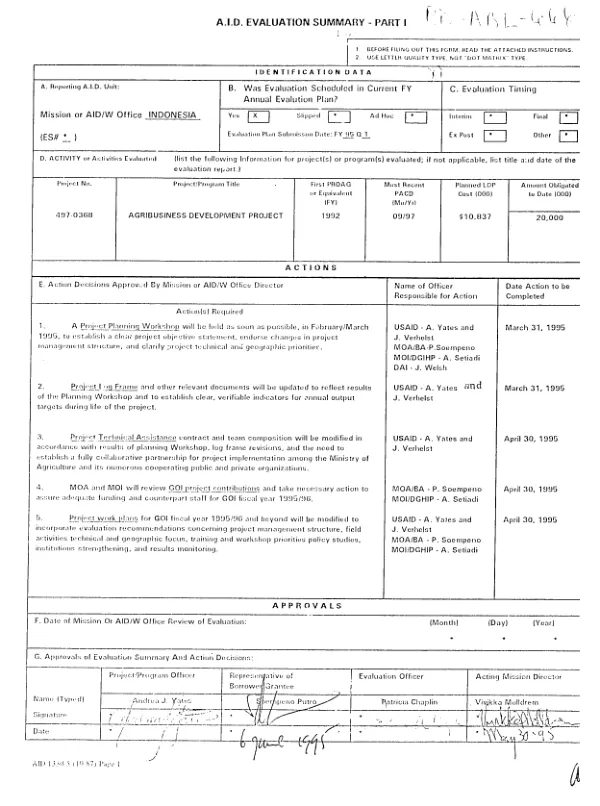
Agribusiness development project
Project to promote agribusiness development in Indonesia by (1) enhancing public sector support for agribusiness and (2) strengthening private agribusiness organizations.
1991
Sign in to readA free account is required to download.
Abstract
The Ministry of Agriculture (MOA) will implement the project with assistance from a U.S. TA contractor. Public sector activities will address three areas. (1) To make the MOA and the Ministry of Industry (MOI) more responsive to the needs of agribusiness, the two ministries will be restructured; the MOA/MOI will develop at least two new services for the private sector in the areas of policies, grades, or standards. (2) The project will help the MOA and the MOI to address both macro-level policy issues and micro-level (subsectoral) regulations that affect production, harvest, transport, processing, packaging, and marketing of particular crops. (3) Several efforts will be made to improve public-private cooperation. Private agribusiness organizations will be given the opportunity in various fora to recommend and advise on policy changes. Public/private cooperation in agribusiness research and development, market development and promotion, and quality assurance programs will be encouraged. Finally, programs will be developed to utilize profits from selected agricultural parastatals in developing small agribusinesses. The project will help private not-for-profit agribusiness producer and trade organizations to provide services to their members and to provide policy input to the government. In the process, these organizations will be linked with the U.S. agribusiness subsector. Initially two organizations, in the fishery and horticulture subsectors, will be assisted. TA, training, and matching funds for activities such as seminars, feasibility studies, attendance at trade shows, and initial visits of potential joint venture partners (both U.S. and Indonesian) will be funded. In addition, the agribusiness organizations will support small and medium-sized farms and agribusinesses, e.g., by helping them to develop specific products and processes, and by developing training and marketing development programs. Project inputs will include TA (7 long-term advisors, and 220 person/months (pm) of short-term TA), as well as some 1,141 pm of short-term agribusiness training, including in-country, regional, and U.S. training. It is expected that the project will lead to the establishment of 100 new agroprocessing firms, increases of $1 billion in total agribusiness trade and of $500 million in agribusiness investment, and the creation of at least 100,000 new jobs.
Related documents