USAID. MISSION TO GUATEMALA
Agribusiness development project
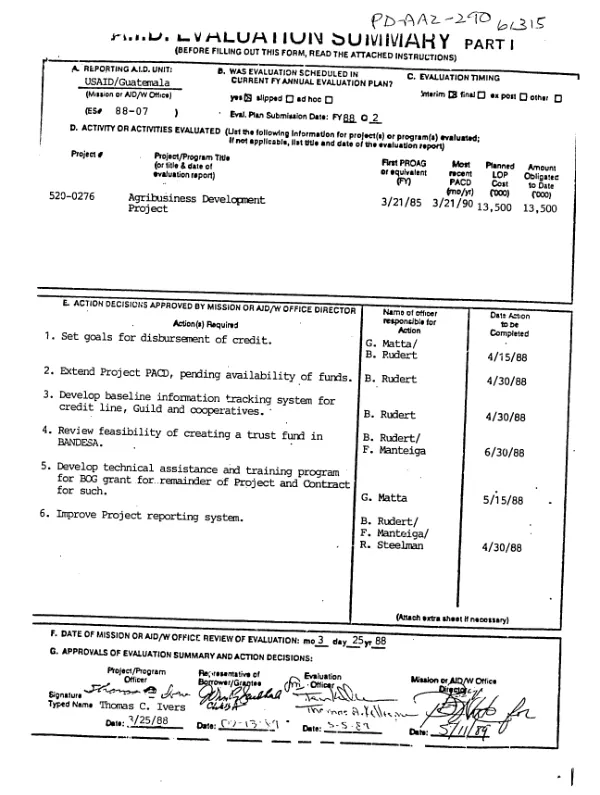
Summarizes midterm evaluation (PD-AAX-289) of a project to raise incomes of small farmers in Guatemala through the sale of nontraditional, high-value commodities and to create employment opportunities through the establishment or expansion of agroprocessing facilities.
1989
Sign in to readA free account is required to download.
Abstract
The project"s loan-based credit line is implemented by the Bank of Guatemala, in conjunction with the private banking sector, and the Agricultural Development Bank (BANDESA). The Guild of Non-traditional Exporters is implementing a grant to develop markets for raw and processed agricultural products, and CLUSA is executing a cooperative development grant. The evaluation covered the period 3/85-11/87, and was conducted on the basis of a review of Project documentation, interviews with Project personnel, and field trips to cooperatives, loan recipients and the Guild"s affiliate office. The major findings and conclusions are: (1) The project has had limited success to date, but prospects for improvement, especially with respect to increased loan disbursements, are good. (2) The impact of the project regarding institutionalization of improved agribusiness credit analysis and loan appraisal capabilities has been minimal. (3) While institutional development of the Guild is proceeding well, it is difficult to measure the benefits accruing to recipients of Guild and CLUSA grants due to a lack of adequate baseline data. Under the credit line, 485 small farmers have improved marketing access, while another 129 have improved their productivity under a single loan. A total of 317 new jobs have been created. (4) A number of cooperatives will not be able to export their products without additional TA beyond that now planned. Additionally, it is doubtful that small farmer cooperatives could manage the CECOMERCA facility. (5) Relatively strong interrelationships have developed among the loan and grant activities. The evaluators noted the following lessons learned: (1) In the design of this type of project, pragmatic lending criteria should be developed, based on realistic expectations. (2) In order to assist small and medium-sized entrepreneurs, a guaranty fund or trust fund should be established. (3) Training courses and seminars should be based on real needs of recipients and evaluated periodically. (4) Credit lines should have sufficient financial or other incentives to enable them to "compete" with others in the same institution, as long as market forces are followed. (5) An accurate baseline survey is important in order to measure progress of beneficiaries. (6) More time is needed than is generally recognized to enable cooperatives to export, and several ""intermediate" stages may be necessary. (7) The lack of an adequate credit mechanism may prevent growth of cooperatives to the point where they can become efficient economic units. Also, if cooperatives have existing debt burdens, these should be restructured prior to embarking upon new ventures. See also abstract of PD-AAX-289. (Author abstract)
Related documents