USAID DEC
Agricultural development : present and potential role of edible wild plants, Part I. Central and South America and the Caribbean
Sign inUNIVERSITY OF CALIFORNIA, DAVIS
Agricultural development : present and potential role of edible wild plants, Part I. Central and South America and the Caribbean
This three-volume, AID-sponsored study on the feasibility of using edible wild plants for food in developing country tropical areas assesses the potential role of edible wild plants in Central and South America and the Caribbean (Volume I), Sub-Saharan Africa (Volume II), and India, Oceania, East and Southeast Asia (Volume III).
Grivetti, L. E. · 1970
Sign in to readA free account is required to download.
Abstract
Based on a search of available literature published in the last 150 years, the report documents dietary uses for wild plants, identifies the nutritional importance of selected species, and examines the potential for research and development (R&D) of such species, in particular for R&D aimed at meeting developing country nutritional needs. Botanical and dietary data on edible wild plants are presented on a country by country basis. Four conclusions are drawn to support further research on edible wild plants: (1) Despite vast information on dietary uses of wild plants, no regions of the world have been thoroughly examined for the potential existence of highly nutritious wild plants. (2) Wild plants, unlike most domestic field crops, are climatically adapted to variable conditions, making them important sources of nutrients during times of drought. (3) Few data are available on the nutritional composition of most edible wild plants. (4) Potential economic uses for wild plants include fiber, oil, dye, and drugs/medicine. Accordingly, the following four recommendations are made: (1) Underutilized or unexploited wild plants should be considered a research priority within A.I.D. agricultural development programs. (2) USAID officials should receive limited discretionary funding (U.S. $20-30,000) to survey target regions for wild plants with potential dietary and non-dietary uses. (3) Teams of qualified anthropologists, geographers, botanists, and nutritionists should be encouraged to apply for such funds. (4) A systematic effort should be launched to develop a nutritional data base on the energy, vitamin, and mineral composition of important edible wild plants. Extensive bibliographies are appended to each volume.
Related documents
Documents in this collection
 1970
1970USAID DEC
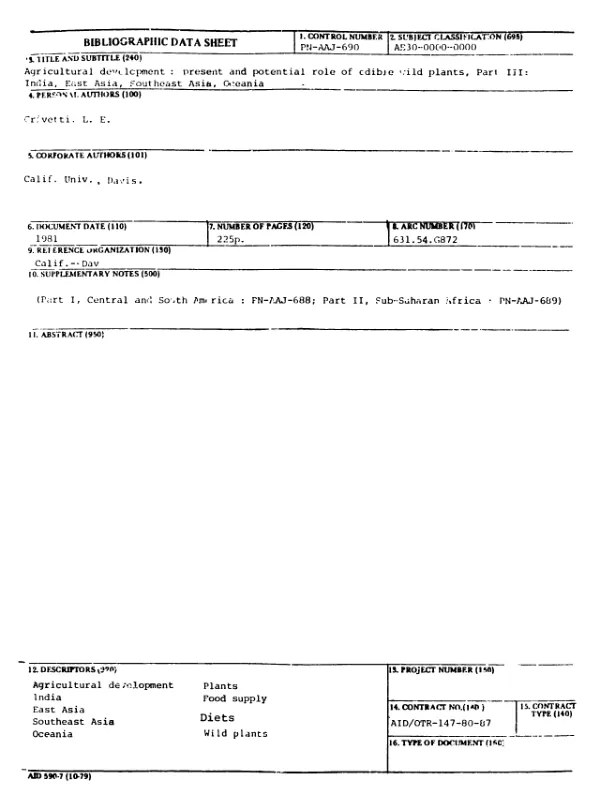
Agricultural development : present and potential role of edible wild plants, Part III. India, East Asia, Southeast Asia, Oceania
Open record 1980
1980USAID DEC