 1979
1979USAID DEC
USAID. MISSION TO THAILAND
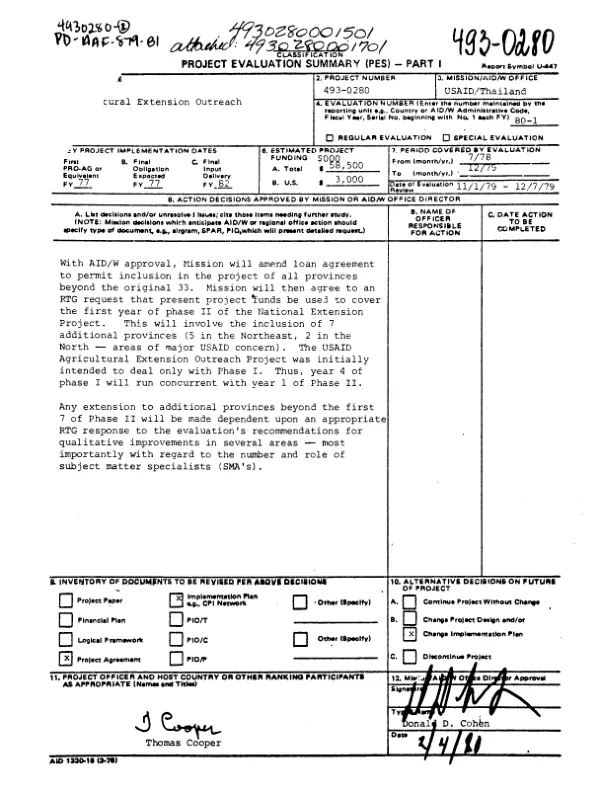
Evaluates project to enable Thailand"s Department of Agricultural Extension to develop a village-level agricultural extension system in 33 provinces.
Jensen, Richard A. · 1978
Abstract
Interim PES is based on a review of project reports and direct field observations. Although the project started 15 months late due to a delay in obtaining the technical services contract, pre-service and in-service training has been provided for 884 participants, including sub-district extension agents (791), district extension agents, subject matter specialists, and training officers, and a Train-the-Trainers Workshop has been conducted for national, regional, and provincial personnel. Routine interaction between extensionists, researchers, and farmers has not been achieved, however, and inadequate planning of the bi-weekly meetings of farmers with district and sub-district personnel has prevented feedback from farmers. Although extensionists have identified over 53,000 contact farmers, it is too early to tell how many farmers are adopting improved technology. Major problems involved the timing of training courses, lack of training expertise on the part of provincial trainers and subject matter specialists, and the ineffectiveness of in-service courses for sub-district agents. There were several unplanned effects. The use of videotape recordings for training purposes was abandoned due to the lack of trained technicians and software and the incompatibility of various makes. Difficulties in expressing the concept of modules in Thai have significantly hampered the development of crop training modules. The potential incompatibility of the dual roles of supervisor and trainer expected of district agents has created problems in the training program at the sub-district level. The project has taught the need for: good communication among project entities; benchmark data prior to the project on project participants; separate positions for supervisor and trainer; less optimistic time frames; and decreased expectations of newly trained personnel. A final lesson is the danger of duplicating training methods from another culture. Eight action decisions are provided.
Connected topics
Classification