USAID. MISSION TO EGYPT
Agricultural management development
Summarizes attached final evaluation (XD-AAU-031-A) of a project to establish a Center for Agricultural Management Development (CAMD) within Egypt"s Ministry of Agriculture (MOA) to train mid-level managers and to resolve management problems in public sector agricultural institutions.
Hopkins, Nicholas; Feteha, Mohammed · 1986
Sign in to readA free account is required to download.
Abstract
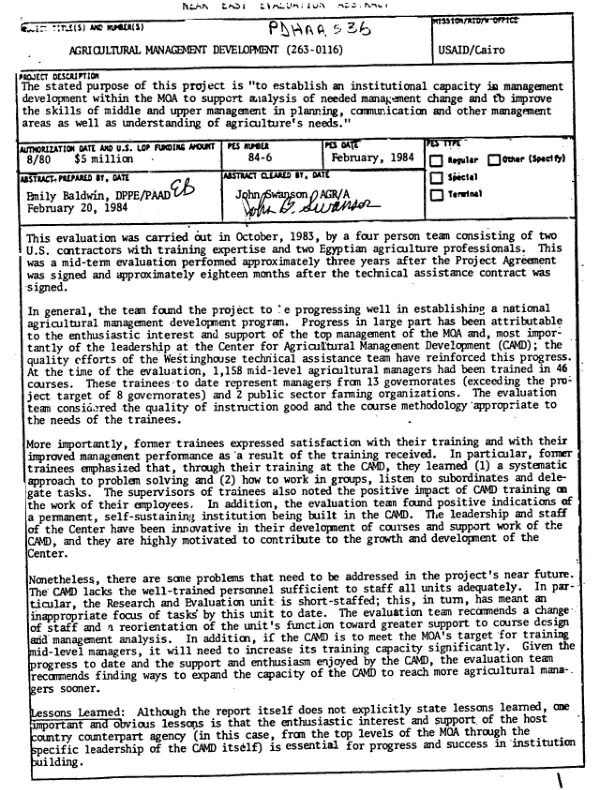
The evaluation covered the period 1980-6/86 and was based on document review, observation of training sessions, and a non-random survey of 143 former trainees. The CAMD, all the facilities of which will be completed by 6/86, has conducted 72 sessions in the basic course, 21 in the advanced course, and a number of special courses. Overall, it has trained about 1,400 (or about 10%) of MOA managers to date. The vast majority of the trainees interviewed were very satisfied with their training, the key deficiency of which was the inadequacy of the case materials drawn from the Egyptian context. The majority of trainees also felt that training improved their job performance, although they consistently reported that lack of understanding by supervisors and the rigidity of existing bureaucratic procedures make it difficult to apply their learning. USAID/E was particularly disappointed with the scanty feedback provided by supervisors. CAMD"s Research and Evaluation Unit has been only marginally involved in analyzing the management problems of public sector agricultural institutions. Needs assessment and follow-up are overly routine. Shortcomings in these areas identified in the 1983 evaluation (see abstract of XD-HAA-536-A) have still not been addressed, for reasons that are not entirely clear, although the lack of progress does indicate USAID/E"s need to strengthen evaluation follow-up. In other areas, CAMD could benefit from clearer job descriptions and lines of authority, and it needs a strategy to integrate itself in the mainstream of MOA activities. Overall, CAMD has strong support from high-level MOA officials and its immediate survival seems assured. It should now build on its area of proven success; specifically, while CAMD should provide services to the National Agricultural Research Project (NARP), it should not let the training of NARP research managers or other special activities detract it from its main task of training mid-level line managers. As to the long term, only the future will reveal whether the CAMD can maintain sufficient critical distance from the MOA (if it is in fact integrated administratively within it) to make a real contribution to increasing agricultural production. It should be remembered, however, that managers play only an indirect and supporting role in agricultural development. Ultimately, improved production depends on farmers.
Related documents