USAID DEC
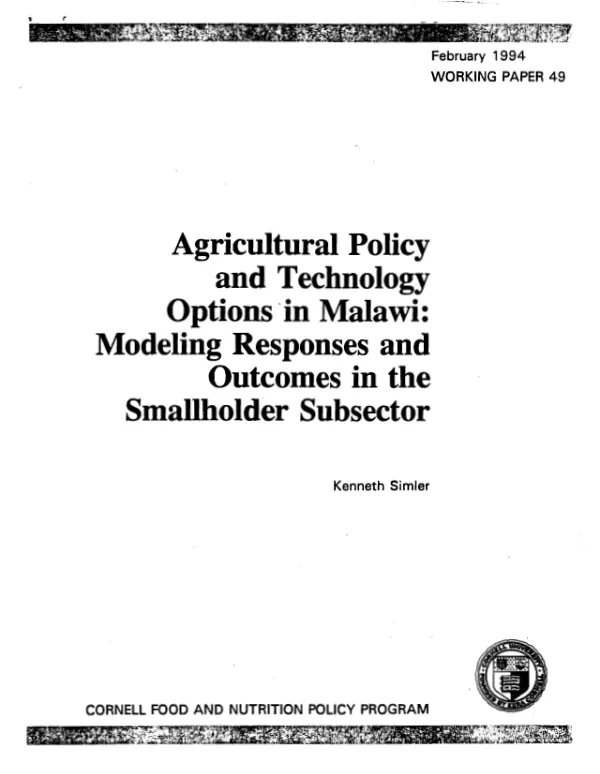
Agricultural policy and technology options in Malawi : modeling responses and outcomes in the smallholder subsector
Sign inCORNELL UNIVERSITY. DIV. OF NUTRITIONAL SCIENCES. CORNELL FOOD AND NUTRITION POLICY PROGRAM
Agricultural policy and technology options in Malawi : modeling responses and outcomes in the smallholder subsector
Despite stagnant performance in recent years, agriculture still provides Malawi the most viable basis for an economic development strategy.
Simler, Kenneth · 1994
Sign in to readA free account is required to download.
Abstract
This paper uses linear programming models to explore the farm and national-level effects of a smallholder-based growth strategy with four major components: flint hybrid maize, burley tobacco, agroforestry, and self-inoculating soybeans. The models are used to simulate the effects in the year 2002/2003 of three policy scenarios: (1) continuation of present policies; (2) policy reform, in which smallholder burley production is allowed to increase to 25 million kg, the supply of flint hybrid seeds is sufficient to meet demand, and agroforestry practices and maize-soybean rotations are allowed on up to a tenth of all cultivated areas; and (3) more rapid reform, with burley production, spurred by additional credit, rising to 50 million kg. Results show that the four-component strategy can revitalize Malawi"s smallholder subsector by raising incomes while increasing food production and consumption. The analysis identifies several areas critical to the success of such a strategy: expanding smallholder burley tobacco licensing; ensuring a sufficient supply of flint hybrid seed; expanding credit availability, especially for the smallest farmers; and encouraging the inclusion of agroforestry and soybean-maize rotations in the farming systems of the very poorest households, who cannot afford the risks of credit or tobacco farming.
Connected topics