PAKISTAN AGRICULTURAL RESEARCH COUNCIL
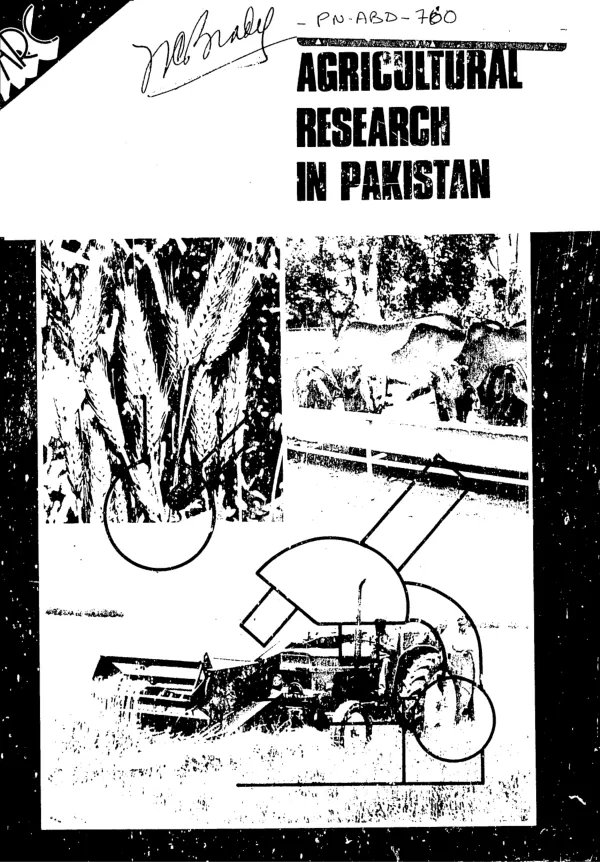
Agricultural research productivity in Pakistan
This study, one of the first to quantify the economic impacts of agricultural research in Pakistan, reports a new analysis of the contribution of agricultural research to crop productivity growth.
Azam, Qazi Tauqir; Evenson, Robert E. · 1990
Sign in to readA free account is required to download.
Abstract
Chapter I presents an overview of the research institutions in Pakistan and documents changes in the system associated with the development of the Pakistan Agricultural Research Council. Characteristics of the system are discussed, some of which are subjected to further analysis in later chapters. Chapter II develops and reports both Partial Factor Productivity (PFP) and Total Factor Productivity (TFP) indexes for Pakistani agriculture. These indexes are computed for most districts, for the 1955-56 to 1985-86 period. This chapter also compares TFP changes in the Indian State of Punjab and the Pakistani provinces utilizing comparable computational methods and data. Chapter III reports a statistical analysis of the determinants of TFP change at the district level. This analysis is comparable to studies in other countries usually referred to as "TFP decomposition" studies. The analysis estimates the contribution of research and infrastructure investments to productivity growth. Chapter IV reports statistical analysis of PFP indexes (yields) for several crops. This analysis, which is more complex than the TFP analysis, provides additional insight into the role of research programs because differences between crop research programs can be observed. Chapter V reports another approach to the analysis of farm production data. It utilizes the basic "duality" relationship between production and maximized profits to specify and estimate a "meta profits function" system of product supply and factor demand equations. The term "meta" is used to indicate that the research and infrastructure variables are directly incorporated into a specification that normally treats them as constant. The final chapter analyzes the economic implications of the estimated parameters. Estimates of benefits based on total (i.e., producer plus consumer) surplus are utilized to compute marginal internal rates of return to investment in research. International comparisons with other studies are also provided. Study findings show that, while not all problems have been solved, investments in agricultural research programs have been among the most productive investments in Pakistan over the past 40 years. Pakistan"s agricultural research system has produced economic growth in agriculture at low cost and that growth has been vital to Pakistan"s rapidly growing population. The study also shows, however, that Pakistan has underinvested in agricultural research; it should have invested more. For an economy like Pakistan"s, the biggest bargains in the process of achieving economic growth are probably its agricultural scientists. Not only are they productive, but they are low cost (about one-tenth of the level in developed countries) -- something Pakistan should keep in mind if it is to maintain per capita food production for a population which will double in the next few years. (Author abstract, modified)