USAID. MISSION TO PERU
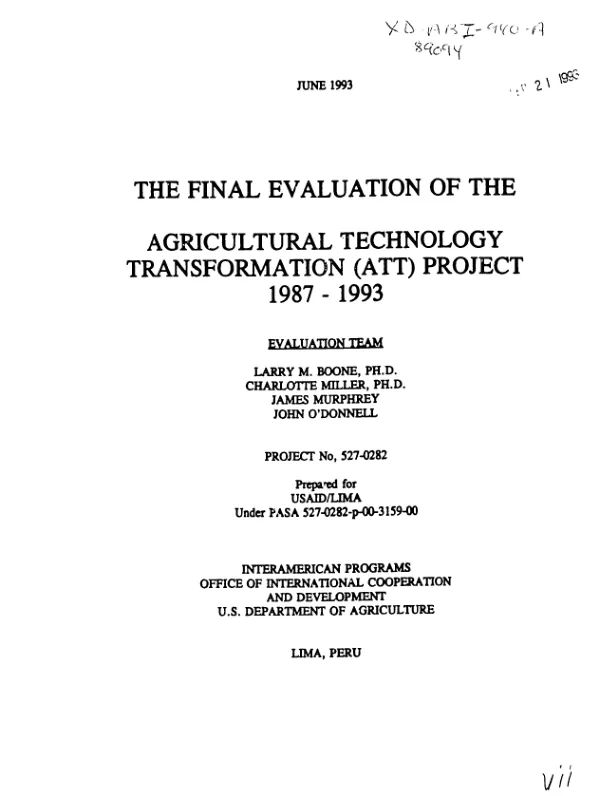
Agricultural technology transformation - ATT
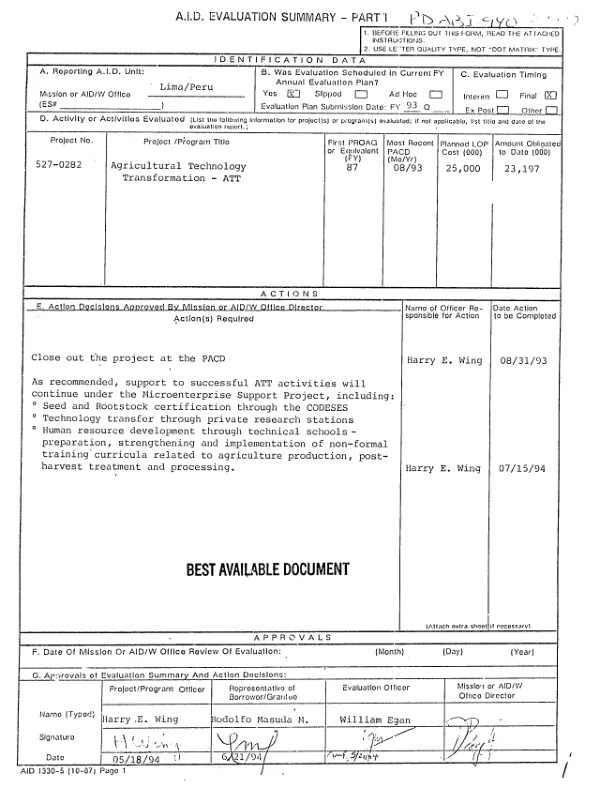
Summarizes final evaluation (XD-ABI-940-A) of a project (1987-8/93) to strengthen Peru"s agricultural technology generation and transfer system through improved public and private sector research capability, enhanced "retailing" of new technologies to farmers, and postgraduate training of agricultural specialists.
1994
Sign in to readA free account is required to download.
Abstract
Although technically well-conceived, the project was too large and complex given Peru"s institutional instability. Much of the project funding was channeled through the Agricultural Development Foundation (FUNDEAGRO), a new agency without seasoned linkages to other public or private sector institutions. The Project Advisory Council -- designated to resolve inter-institutional issues and guide policy -- did not function at all. This lack, along with the severe financial constraints imposed by lack of early counterpart funding, imposed heavy management burdens on all concerned, resulting in lack of focus and dilution of support for the National Institute of Agricultural Research (INIA) and other participating institutions. Moreover, there was inadequate emphasis on demand driven research and technology. The National Institute for Agricultural Research (INIA) emerged from the project leaner and more organized and has produced new varieties and technologies, but needs additional help in prioritizing and streamlining its research agenda and in focusing research on farmers" perceived needs and on economic criteria for specific technologies. The research grants programs of FUNDEAGRO and the National Agrarian University at La Molina (UNALM) had limited success, but show promise. INIA and the project produced a large volume of media extension materials; however, the materials lacked focus, concentrated on introducing new crops to the exclusion of other elements of agricultural production, and were not linked with field-oriented instruction. The situation was exacerbated by a shortage of skilled public sector extensionists; only 3 of the 55 technology transfer specialists trained under the project remain with INIA. The effort to create private "Technology Transfer Enterprises" by privatizing eight INIA coastal research stations was only marginally successful, since the new entities will continue to need services from INIA; it might have been wiser to focus efforts on strengthening existing farmer service organizations. Insufficient attention was given to the enterprises" economic viability and where they fit within the institutional spectrum. The improved seed program was successful, although the eight Departmental Seed Committees (CODESEs) must increase their rate of seed certification if they are to achieve economic sustainability. UNALM clearly has succeeded in strengthening its research and extension teaching programs and improving student and faculty incentives, although largely at its own expense, given its late entry into the project. At the time of the evaluation, all 21 overseas M.S. and Ph.D. students and one-third of in-country M.S. students had completed their studies. UNALM launched a successful "partial scholarship" program to help the remaining in-country trainees complete their programs. Helped by limited funding from the project, UNALM"s National Agricultural Library has improved its electronic materials storage capability and broadened links to other users and information sources. Lessons learned are as follows. (1) Large-scale projects aimed at altering relationships among a number of public and private institutions in a volatile political climate should be carefully partitioned and phased over time. (2) Project funds should be channelled directly to participating institutions rather than through ad hoc entities such as FUNDEAGRO created for other purposes under the project. Such ad hoc organizations rarely work well as project coordinators. They lack institutional legitimacy. (3) Efforts to privatize public sector research and transfer functions should, wherever possible, focus upon support for already existing private sector agricultural service enterprises more directly attuned to farmers" needs. An action decision is to follow the evaluation"s recommendation to continue the successful project activities under the Microenterprise Support Project, including seed and rootstock certification, technology transfer through private research stations, and human resource development through technical schools.