UNIVERSITY OF JORDAN. FACULTY OF AGRICULTURE
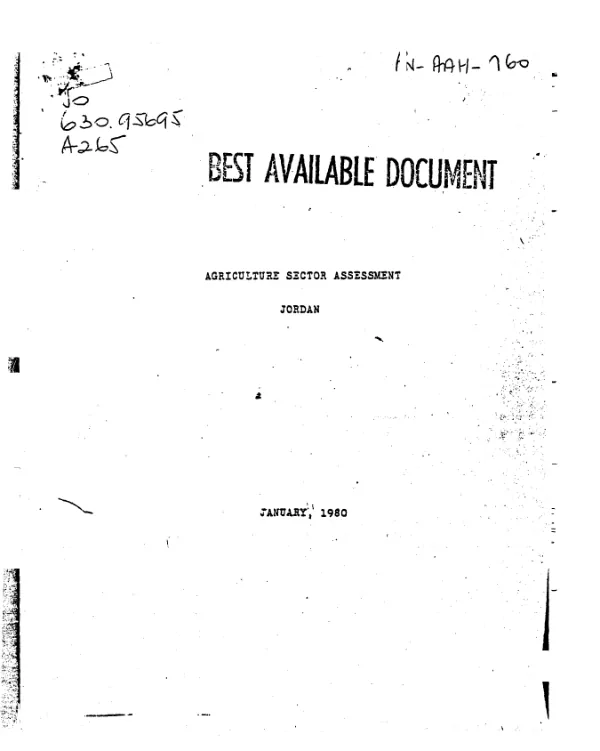
AGRICULTURE SECTOR ASSESSMENT JORDAN
In order to plan for future agriculture programs in Jordan, USAID commissioned the University of Jordan (UOJ) to review the country"s agriculture sector.
1970
Sign in to readA free account is required to download.
Abstract
This report presents the results of that review, along with USAID"s perception of opportunities and constraints on future strategies for agricultural change. In Part I of the report, data on crop and livestock production and on labor and import levels in the country are presented. Differences in upland and valley topographies and agricultures, especially those of land under cultivation, along with rainfall, crop distribution, land holdings, and livestock are discussed; and upland watershed development and protection and the valley"s irrigation needs are analyzed. Part I also describes changes in valley agriculture (such as increased reliance on plastic tunnels and mulch), current institutional support systems, and the manpower development activities of the UOJ and the Ministry of Education. Part II states USAID"s conclusions and recommendations. Because Jordan"s rapid economic and employment changes make its situation so unique, no clear indications of an overall agriculture sector strategy exist. USAID will focus on helping to reduce the country"s dependence on foreign subsidies by increasing production of high value crops for export; a secondary goal will be to lower food prices for the poor, most of whom are urban. At Jordan"s request, USAID efforts will be concentrated in the Jordan Valley, which has the greatest potential for increased yield and incomes, and where the availability of capital, high farmer motivation, and attractive market prices favor sector development. USAID will emphasize the removal of sector constraints by encouraging the adoption of higher productivity technology, more efficient use of current technology, improvement of technology and information transfer to farmers, and strengthening of agricultural services, especially through support of valley organizations. A review of watershed protection and development activities to determine the potential for increased irrigation will be encouraged.
Related documents