USAID DEC
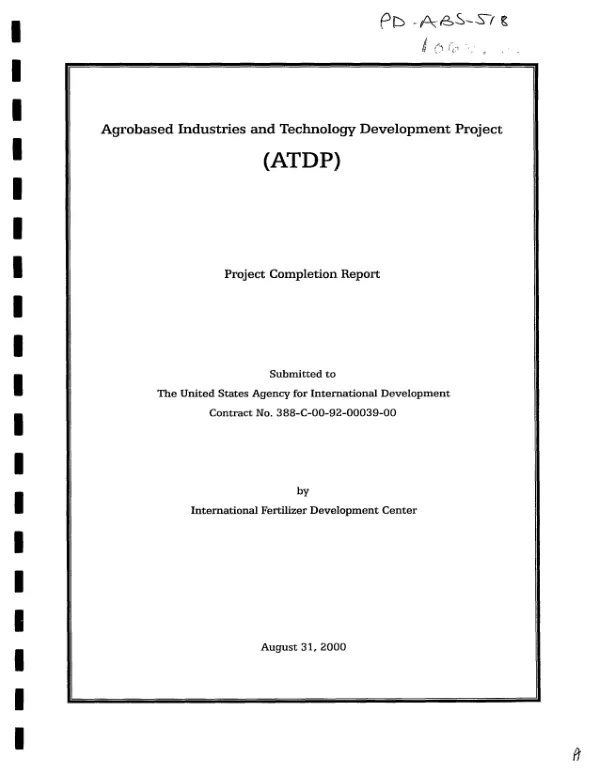
Agrobased industries and technology development project (ATDP) : project completion report
Sign inINTERNATIONAL FERTILIZER DEVELOPMENT CENTER (IFDC)
Agrobased industries and technology development project (ATDP) : project completion report
Final report of the International Fertilizer Development Center (IFDC) on the Agro-based Industries and Technology Development Project (ATDP -- 1/95-8/00), designed to promote commercial agribusiness in Bangladesh.
Waterman, Dan; Jahan, Ishrat · 2000
Sign in to readA free account is required to download.
Abstract
The ATDP met or exceeded five of six primary contract targets: 700,000 farmers, vs. a target of 100,000, adopted more productive, environmentally sound technologies; contract grower arrangements numbered 172, vs. a target of 80; agribusiness investment loans totaled 12,700, vs. a target of 7,000, representing $257 million in credit and investment, 2.5 times the goal; and over 50 significant policy reforms were enacted. On the down side, only 70,000 new jobs in agribusiness were created, vs. a target of 130,000. Critical to the project"s impact were its synergistic alliances with local organizations and leveraging of staff and training resources. In the process, ATDP helped build the capacity of these local institutions and disseminate improved technologies more broadly. From the beginning, ATDP partnered with the Department of Agricultural Extension and government research services to commercialize breakthrough technologies such as urea supergranules (TJSG), which enables farmers to more than double their income. Through collaboration with NGOs, notably the Bangladesh Rural Advancement Committee (BRAC), the project indirectly reached tens of thousands of smallholders. The solid success of pilot activities such as the model poultry villages has stimulated their replication by the influential Grameen Bank. Achievements highlighted by the final evaluation team included: improved packaging and pre-cooling techniques that helped increase vegetable exports by $5.6 million during 1997-99; a 1999 business mission for shrimp processors to the United States that generated $18 million in spot orders and $35 million in follow-up purchases; and establishment of a federation of agribusiness trade associations. Thanks to ATDP support to borrowers, the loan recovery rate from credit generated through the Government of Bangladesh (GOB)-funded Agribusiness Credit Fund (ACF), which provided vital liquidity and spurred banks to lend to nascent agro-enterprises, is 95%. The project also: successfully recommended that the GOB budget for 2000/01 adopt 37 tax reductions, averaging 75%, on agricultural-related inputs; prepared a major analysis to prepare the GOB for Uruguay Round Agreement and World Trade Organization obligations; produced a monthly agribusiness bulletin that quickly became a pre-eminent source of practical technology and information; and conducted 105 overseas study and business missions for 325 people. Clients imported $100 million in U.S. goods. Through consultancies with clients, ATDP: demonstrated how to modernize the potato industry; supported the dynamic growth and diversification of the largest agro-processor; increased fruit and vegetables exports for assisted client enterprises -- from $120,000 in 1998 to $290,000 in 1999; and, through Poverty Alleviation, Gender Equity and Environment (PAGE), an NGO in Comilla, helped 300 poor farmers, mainly women, begin exporting vegetables and thereby raise their incomes by 30%. Lessons learned are as follows: (1) An integrated, reinforcing package of assistance to entrepreneurs over sufficient time is critical to fostering agribusiness growth in Bangladesh. Programs must be demand-driven, customer-oriented, hands-on, flexible, and aimed at sustainability. (2) There should be focus on commodity chains and on constraints throughout the vertical production, processing, and marketing systems. (3) The private sector and its trade associations are effective channels to transmit technology and to improve policy, regulatory, food safety, and marketing regimes. (4) Banks, NGOs, and government agencies can help leverage resources and outreach. Progressive enterprises are critical to building linkages and institutional capacity. (5) Tangible results produced early will stimulate demonstration and multiplier effects. (6) Developing sustainable agro-enterprises generally requires tailored business and technical support as well as access to credit. Overall, ATDP had a positive impact that resonated throughout the private, NGO, and public sectors. According to a former Deputy Minister of Finance, ATDP transformed subsistence agriculture into an industry.
![Kosovo emergency agri-input program [KEAP], October 1999-May 2000 : completion of project report](https://covers.devme.ai/gen/17236.webp)