USAID. MISSION TO HAITI
Agroforestry outreach project
Summarizes attached end-of-project evaluation for the period 9/81-1/86 (XD-KAI-175-A) of an agroforestry outreach project in Haiti.
Cusumano, V.; Wilson, R. · 1986
Sign in to readA free account is required to download.
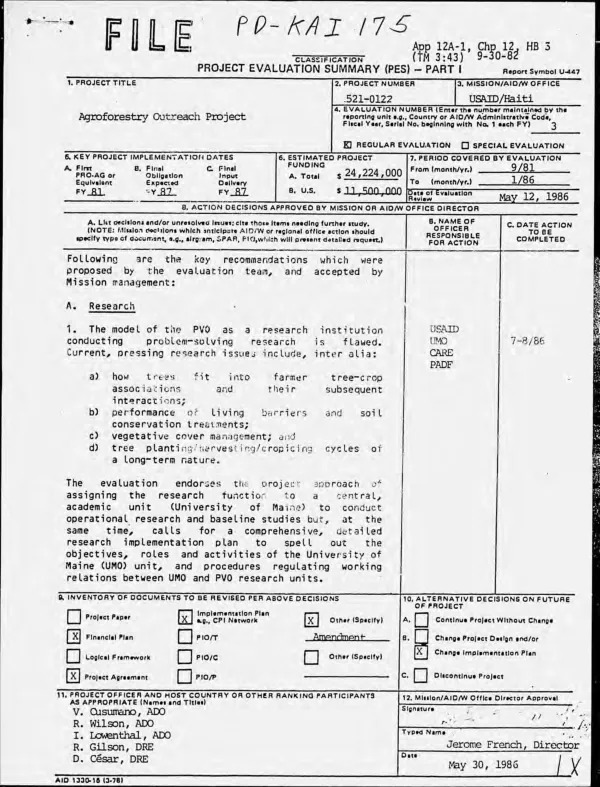
Abstract
The evaluation covered the period 9/81-1/86 and was based on site visits and interviews with concerned personnel. As noted in earlier evaluations, farmers are being motivated to plant substantial numbers of trees on a for-profit basis. However, they are far less motivated to maintain the trees properly, especially when significant additional labor is required; to alleviate this problem, farmers should be provided with the most hardy and vigorous seedlings available at reasonable cost. CARE and the Pan American Development Foundation (PADF), two of the three PVO"s implementing the project, made significant progress in extension and training - areas cited as weak in earlier assessments. There have, however, been serious difficulties in acquiring quality seed and in maintaining quality control and standardized procedures throughout the nursery network. Also, reporting has remained inadequate, resulting in a lack of reliable data regarding tree survival. Several lessons were learned. (1) Project success in tree planting depended largely on tying these efforts directly to peasants" economic self-interest. This approach, however, can hinder attainment of the project goal of soil conservation. Project management should first demonstrate the economic benefits of plantings to farmers, and then begin to combine plantings with soil conservation measures. (2) The promotion of large landholder tree farms (as the third PVO, Operation Double Harvest, was mandated to do) was not a cost-effective means of servicing urban fuel and other needs, due to high land preparation costs and the length of time needed to market the most profitable products. This conclusion also shows the validity of the project approach of including different planting modalities in its design. Activities relating to these farms should be discontinued. (3) Field studies, supported by a preliminary cost-benefit analysis, show that farmers are satisfied with the economic yield from project trees and plan to continue planting them. (4) The use of the University of Maine (UM) rather than the PVO"s to conduct problemsolving research was sound, although there is need for a comprehensive plan to address outstanding research issues and to clarify the functions of the UM team and its relation to the PVO research units. Given the favorable evaluation and the project"s high priority with USAID/H, a key action decision is to approve a 3-year expansion period with substantially increased funding.