USAID DEC
AID cooperative agreement no. 645-0234-A-00-0012-00 with Business Management Extension Programme for a program in small entrepreneurial development
Sign inUSAID. MISSION TO SWAZILAND
AID cooperative agreement no. 645-0234-A-00-0012-00 with Business Management Extension Programme for a program in small entrepreneurial development
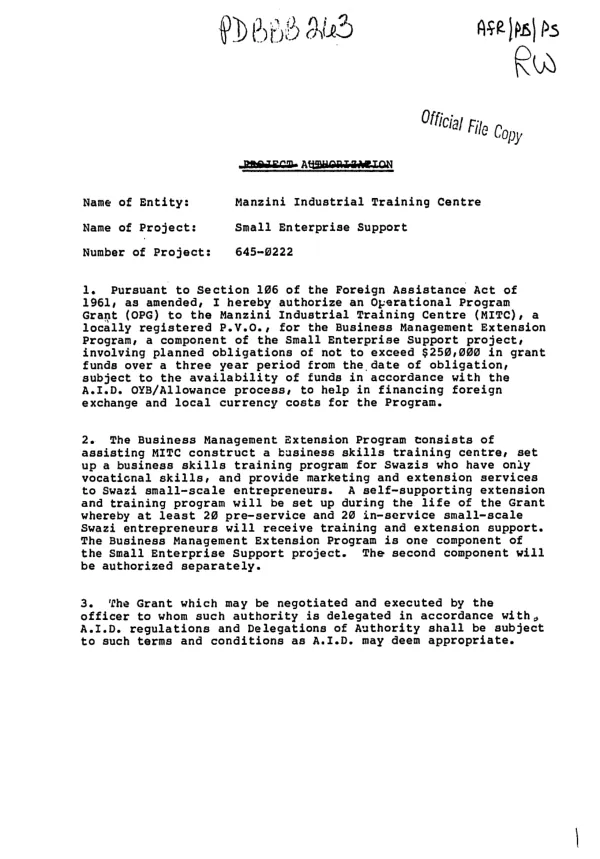
Grant to Business Management Extension Program (BMEP, established under project 6450222) to identify and implement business management training methods and other activities that will support small businesses in Swaziland.
1990
Sign in to readA free account is required to download.

Abstract
The BMEP will: (1) offer business training and extension; (2) establish a business resource center; (3) provide commercial loans; and (4) demonstrate a successful retail enterprise. CARE will help implement the project. BMEP will offer a six-week, full-time training course three times a year. The course will be tailored to the Swazi business environment; training will follow a participatory, hands-on approach which will help trainees design their own business plans. About 30 new entrepreneurs are expected to graduate annually, and follow-up assistance will be provided. BMEP will also offer business extension services in such areas as business plan implementation, access to credit, product quality, and business motivation, as well as part-time business courses. Over a 2-year period, the extension activities will reach some 60 individuals and 40 rural community groups, while about 40 individuals will benefit from part-time training. A resource center located within BMEP will offer informational booklets on manufacturing sector skills and on such skills as bookkeeping, pricing, and marketing. Information and advice will be available on areas such as company registration, tax law, and raw materials acquisition, and counseling will be available to persons seeking more in-depth business advice. A minimum of eight people per day, as well as rural education centers, women in development groups, and similar organizations, are expected to use the resource center. A revolving commercial loan scheme, which will be able to serve 50 clients at a time, will be established. The scheme will have well-defined procedures of selection, loan agreement and collection, handling of defaulters, loan monitoring, etc. Loans will be overseen by a committee composed of BMEP staff and bank, legal, and business representatives. Finally, a demonstration retail outlet, Eswatini, has been established as a profitmaking business. It provides an example of how a locally owned business, depending solely on local products, should be managed. The outlet will provide a discretionary fund for the extras required by the main program. A warehouse facility that buys in bulk is also firmly established, and will provide goods which are difficult to obtain.
Related documents