USAID DEC
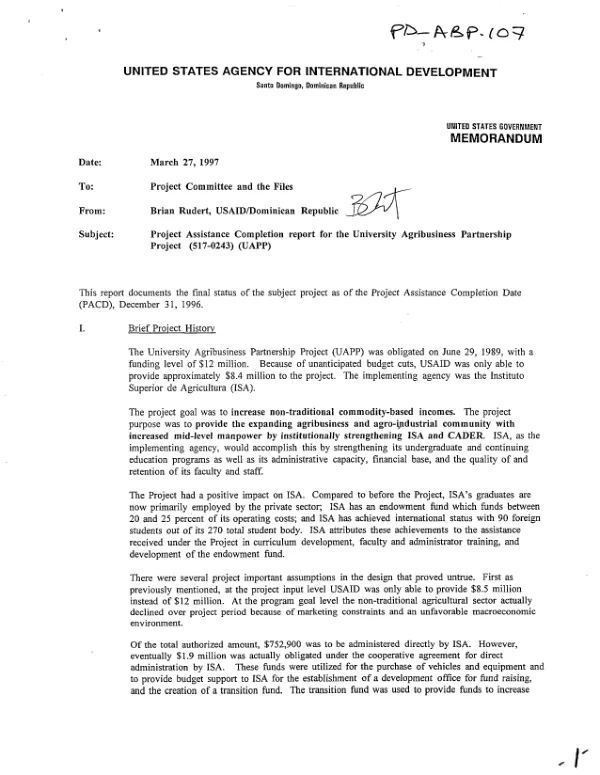
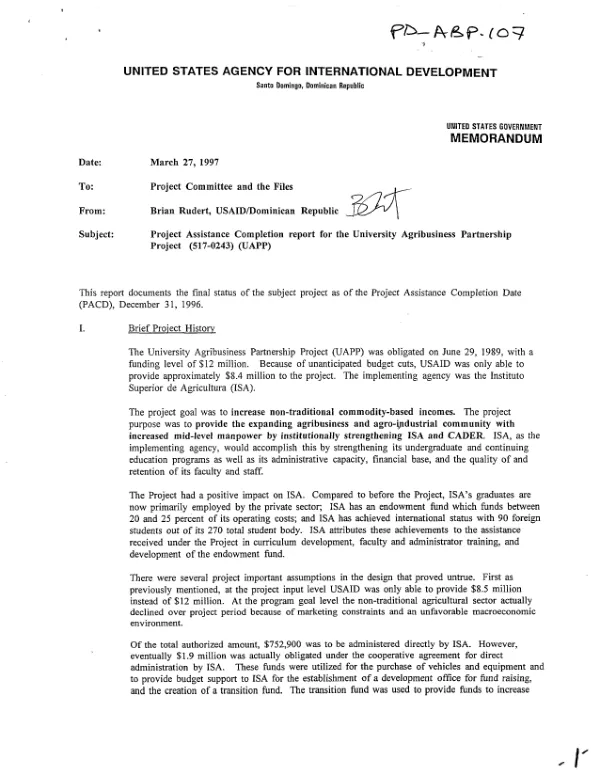
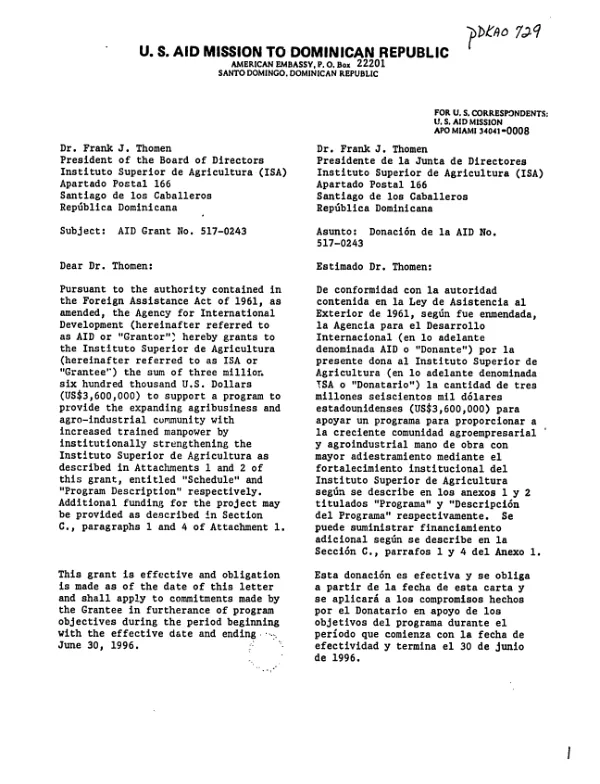
AID grant to Instituto Superior de Agricultura (ISA) to provide the expanding agribusiness and agroindustrial community in the Dominican Republic with increased mid-level manpower by institutionally strengthening ISA
Sign inUSAID. MISSION TO DOMINICAN REPUBLIC
AID grant to Instituto Superior de Agricultura (ISA) to provide the expanding agribusiness and agroindustrial community in the Dominican Republic with increased mid-level manpower by institutionally strengthening ISA
Project to increase the capacity of the Dominican Republic"s Instituto Superior de Agricultura (ISA) to train personnel for the nation"s growing agribusiness sector, especially in areas relating to nontraditional commodities.
1989
Sign in to readA free account is required to download.
Abstract
ISA will implement the project, which will include faculty/staff training, curriculum development, research and outreach, establishment of a development office, and support for faculty salaries. To ensure that ISA will be able to meet its core costs, including adequate faculty salaries, the project will expand ISA"s endowment fund (using resources from the government"s local currency program and private sources) and will establish a development office responsible for fundraising, alumni/community relations, and donor coordination. In the interim, the project will increase faculty salaries by up to 100%, and it will institute a merit bonus system. TA, training, and faculty exchanges will be provided to ISA by a consortium of U.S. institutions - Midwest Universities Consortium for International Activities, the University of California/Davis, Texas A&M, the Academy for Educational Development, and J.E. Austin Associates. This will include TA/training in planning, management, accounting, and computers for several ISA administrative units and for its Center for Economic and Food Research, and its Center for Rural Development and Administration (CADER). ISA"s teaching, research, and extension programs will be strengthened in 3 disciplines via TA and the training (long- and short-term, nondegree) of some 40 faculty. This will include establishment of B.S. programs in horticulture and forestry and of a technical degree program in forestry, and strengthening of existing technical programs in horticulture and animal production. In horticulture, priority will be given to research in nontraditional crops (e.g., tomato, pepper, tropical fruits) and related areas such as seed production and pest control. The animal production department will focus on, inter alia, meat and dairy production, animal health and nutrition, and pasture management. With respect to forestry, stress will be on continuing wood fuel research begun under 5170144 and on new research in watershed management and related areas. Outreach by the 3 departments will include: policy seminars and workshops on nontraditional commodities, farmer field days, consulting, publications, short courses, radio spots, and dissemination of research findings to the private sector. Finally, CADER"s agribusiness program will be helped to forge closer ties with the private sector (e.g., through better services and an improved internship program), and to develop more profitmaking services (e.g., consulting, executive courses).
Related documents
Documents in this collection
 1987
1987USAID DEC