USAID DEC
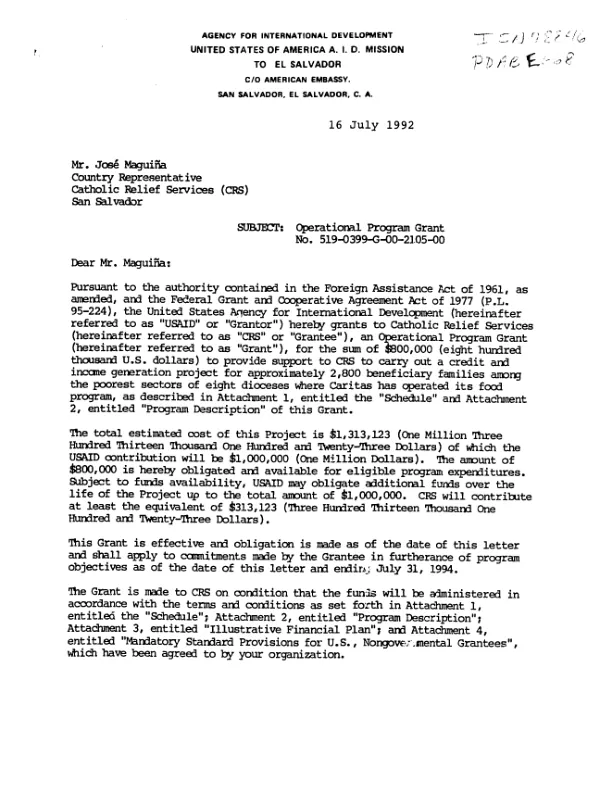
AID operational program grant no. 519-0399-G-00-2105-00 to Catholic Relief Services (CRS) to carry out a credit and income generation project
Sign inUSAID. MISSION TO EL SALVADOR
AID operational program grant no. 519-0399-G-00-2105-00 to Catholic Relief Services (CRS) to carry out a credit and income generation project
OPG to Catholic Relief Services (CRS) to support productive enterprise initiatives in El Salvador by providing credit and TA to some 2,800 families in poor areas in 8 dioceses in which Caritas (CRS" Salvadoran affiliate) has operated a food aid program.
1992
Sign in to readA free account is required to download.
Abstract
The project will have two components: village banking, and revolving agricultural loan funds (RALF"s). The project will establish 40 village banks with 1,200 members in 3 Caritas diocesan offices. The FINCA (Foundation for International Community Assistance, a U.S. PVO) village banking methodology will be used, and FINCA/El Salvador will provide training and TA to project personnel, including six village bank promoters who will be hired under the project. FINCA estimates that for every $50 in credit invested under the program, a bank member will generate net income of about $10 a month. Since under the FINCA methodology each bank member must deposit about $125 over 2 years in the bank, a typical bank after 3 years would be financially strong enough to "graduate" and return the amount of loan capital it initially received to the diocesan Caritas. The capital will then be used to create new village banks. Under the second component, 5 diocesan Caritas offices will organize 1,600 small farmers into 75 community RALF"s with an average of 18-25 farmers each. Membership criteria will favor those who have participated in CRS" maternal/child health program, were directly affected by the war, live in the poorest communities in the diocese, have experience in small-scale farming, rent land, and have the approval of other RALF members. Caritas will manage the financial aspects of the RALF"s for 2 years, after which all management will remain at the community level. RALF members will be trained in elementary financial control and basic accounting, and RALF community credit committees will receive indepth training on rotating funds, their organization and committee functions, and how to access credit within the formal banking system. Training for national and diocesan Caritas staff will focus on RALF management and on working with the formal banking system. In addition, the project will finance the hiring 7 agricultural extensionists by diocesan Caritas. One Caritas extensionist will be trained in pest/pesticide management, and the project will provide practical field training to RALF members in the areas of production, marketing, and postharvest operations. Annual workshops will be held on the use of agrochemicals. Finally, Caritas will develop an information system, to include data on RALF participants, crop planted, costs, yields, and prices realized, and will update its manual on implementing a RALF.
Related documents
Documents in this collection
 1998
1998USAID DEC
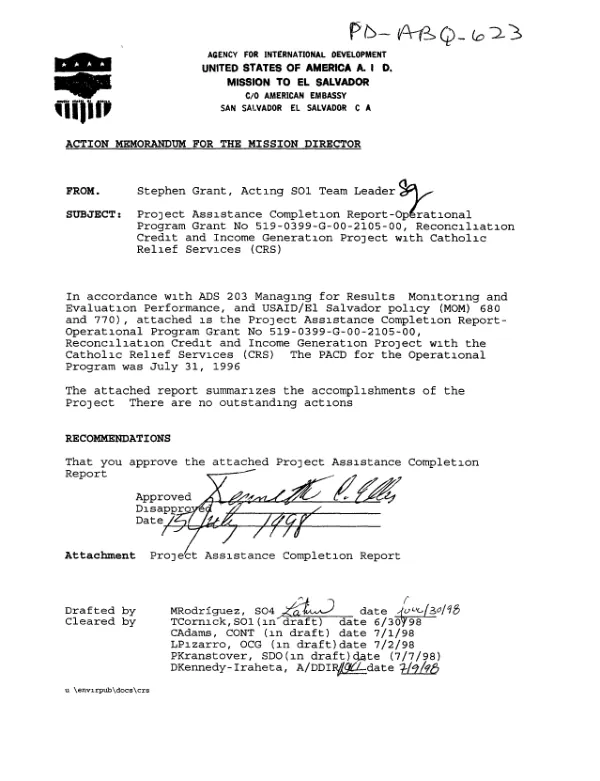
Project assistance completion report : operational program grant no. 519-0399-G-00-2105-00 -- reconciliation credit and income generation project with the Catholic Relief Services (CRS)
Open record 1998
1998USAID DEC