USAID. MISSION TO MALAWI
AIDS/STD awareness and prevention
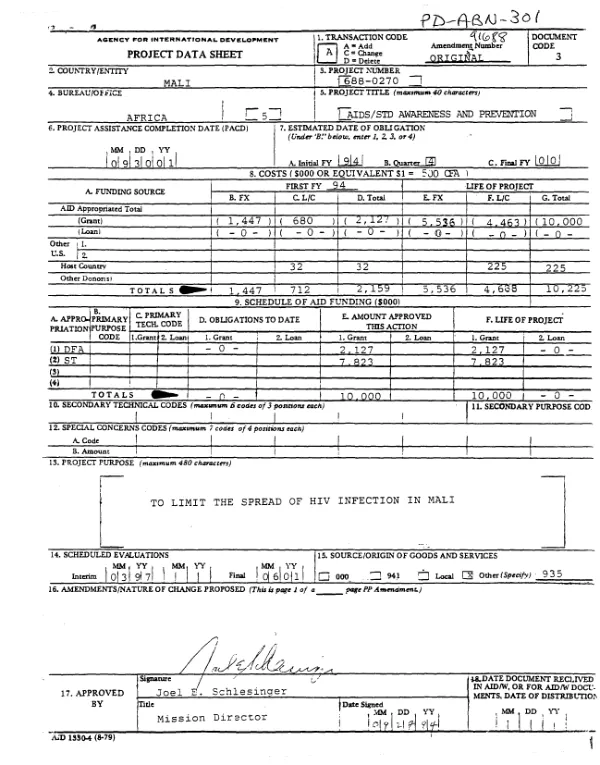
Project to limit the spread of HIV/AIDS and other sexually transmitted diseases (STDs) in Mali through: (1) STD control; (2) HIV/AIDS awareness and condom promotion for behavior change; and (3) policy development and coordination.
1994
Sign in to readA free account is required to download.
Abstract
Under the first component, improved control of STDs -- and thereby of HIV/AIDS -- will be achieved through improved STD case management, improved surveillance and reporting, and improved STD institutional capacity at the National AIDS Committee (NAC). Some 350 health workers will be trained to use World Health Organization algorithms for syndromic diagnosis and in counseling to prevent infection. Basic STD laboratory equipment will be supplied to all 46 district level health centers. Operations research will be conducted to identify the optimal strategies for STD and HIV control in Mali and provide ongoing input to STD case management. The essential drugs list will be revised to include first line drugs for all major STDs. Improved STD surveillance and reporting will be achieved by incorporating syndromic definitions of key STDs into the national health information system; equipping HIV sentinel surveillance sites with STD laboratory equipment; conducting rapid surveys to determine the overall evolution of STDs in Mali; and revising treatment protocols based on information received from the results of operations research. The STD institutional capacity of the NAC will be improved through providing a long-term specialist in STD control and long-term training for two NAC staff members with the requirement that they return and work for the NAC. Finally, key health personnel will be trained to notify all seropositive persons of their results and to provide pre- and post-test counseling in ways to avoid disease transmission. Under the second component, the project will develop an umbrella organization to administer up to 25 subgrants to NGOs for STD and HIV/AIDS information, education, and communication activities (IEC) aimed at the general population and at high-risk groups. IEC campaigns will especially target community health centers in Segou, Koulikouro, Mopti, and Kayes using techniques that will include video, theater, focus groups, round table discussions, and football matches. Peer-to-peer education will also be emphasized (e.g., prostitutes will work with prostitutes). General training in AIDS prevention and awareness methods will be provided to individuals involved in non-AIDS-related development such as credit, microenterprise development, and natural resource management. IEC activities will be reinforced by community-based marketing of condoms, development of counseling policy and training of medical staff in pre- and post-test counseling techniques, and establishing support groups for seropositive individuals and their families. Rapid, knowledge, attitude, and practices surveys will be conducted before and after major information campaigns. Under the final component, the project will provide long- and short-term TA, training, and institutional support to help the NAC engage in information exchange, policy development, and resource mobilization. A quarterly newsletter on STD and AIDS in Mali will provide a forum for information and exchange for donors, health planners, and NGOs. In collaboration with the Government of Mali and the Ministry of Health, clear-cut policies will be developed on HIV/AIDS related counseling, free distribution of condoms, and STD prevention and control. Regular meetings of donors and NGOs will be held to improve coordination and the allocation of resources. Two studies of the socioeconomic and demographic impact of HIV/AIDS will be conducted, and the NAC will be supplied with the AIDS Impact Model -- a computer model that projects levels of prevalence of AIDs and predicts its socioeconomic effects over the next 5-25 years. These resources will be used to develop a series of presentations for policymakers at national and regional levels on the potential socioeconomic impact of HIV/AIDS in Mali in order to increase awareness of and support to the fight against AIDS.
Related documents