USAID DEC
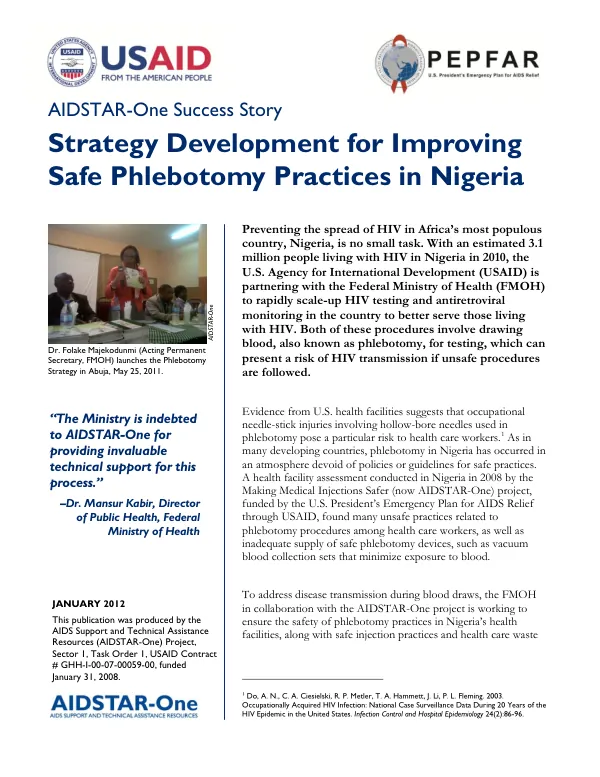
AIDSTAR-One Success Story: Ensuring the Availability of Safe Injection Commodities in Nigeria
Sign inJOHN SNOW INTERNATIONAL
AIDSTAR-One Success Story: Ensuring the Availability of Safe Injection Commodities in Nigeria
AIDSTAR-One's efforts in Nigeria focused on ensuring the availability of safe injection commodities.
2012 · 2 pages
Sign in to readA free account is required to download.
Abstract
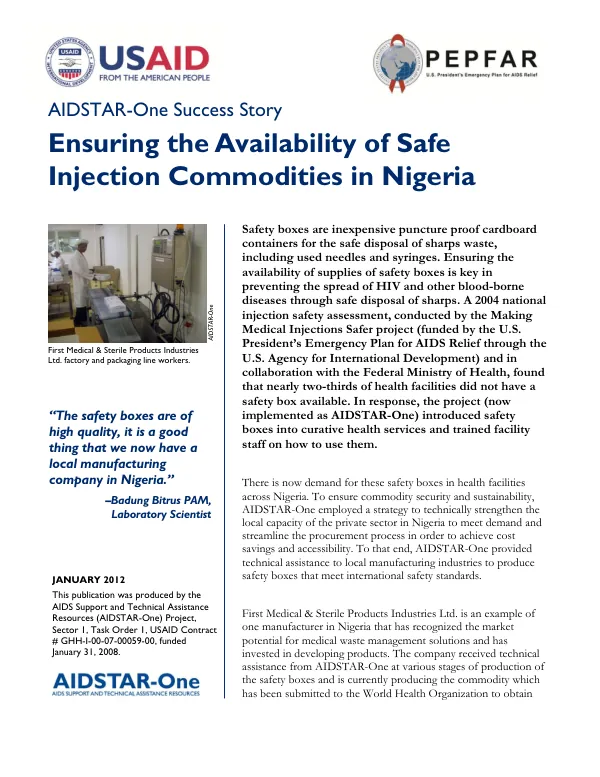
A 2004 national injection safety assessment found that nearly two-thirds of health facilities lacked safety boxes for the disposal of sharps waste, including used needles and syringes. This led to the spread of HIV and other blood-borne diseases. In response, AIDSTAR-One introduced safety boxes into curative health services and trained facility staff on their use. The project also employed a strategy to strengthen the local capacity of the private sector in Nigeria to meet demand and streamline the procurement process. This involved providing technical assistance to local manufacturing industries to produce safety boxes that meet international safety standards. First Medical & Sterile Products Industries Ltd. is an example of a manufacturer in Nigeria that has recognized the market potential for medical waste management solutions. The company received technical assistance from AIDSTAR-One at various stages of production and is currently producing safety boxes that have been submitted to the World Health Organization for certification. AIDSTAR-One's assistance helped improve the quality of the product, increasing the availability of safe injection supplies in the country. The company's Managing Director credited AIDSTAR-One with the success of their safety box business, stating that the encouragement and support received from the organization was instrumental in their development. AIDSTAR-One successfully linked health facilities with the company, enabling managers to procure safety boxes locally. Laboratory Scientist Badung Bitrus PAM noted that the safety boxes are of high quality and that having a local manufacturing company in Nigeria is a significant advantage. AIDSTAR-One's efforts have contributed to the increased availability of safe injection commodities in Nigeria. The project's focus on strengthening the local capacity of the private sector has helped to meet demand and streamline the procurement process, ultimately reducing the risk of HIV and other blood-borne diseases through safe disposal of sharps waste.
Related documents