USAID DEC
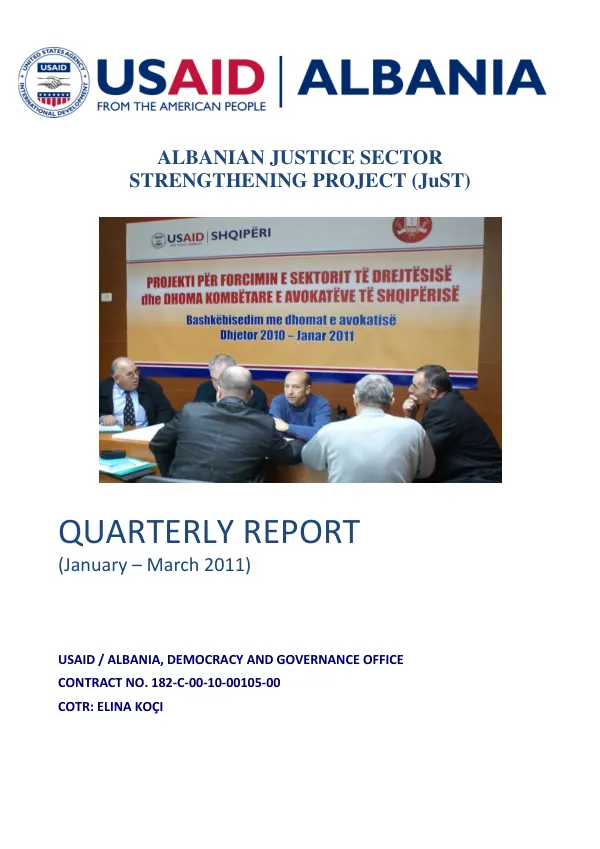
Albanian Justice Sector Strengthening Project (JuST) Quarterly Report for January – March, 2011
Sign inCHEMONICS
Albanian Justice Sector Strengthening Project (JuST) Quarterly Report for January – March, 2011
The Albanian Justice Sector Strengthening Project (JuST) is a five-year initiative aimed at improving the justice delivery system in Albania.
2011 · 11 pages
Sign in to readA free account is required to download.
Abstract
The project is part of the ongoing U.S. support to the rule of law and good governance in Albania, with an emphasis on improving justice delivery and increasing public demand for accountability in the justice sector. The project works in three broad and inter-related areas: increasing court transparency, fairness, and efficiency; promoting accountability from the "grass roots" level by bolstering the watchdog and anticorruption roles of civil society organizations and the media; and strengthening the legal profession and legal education in Albania. During the second quarter of the project, a number of tasks called for in the project work plan were initiated and completed. A comprehensive communications strategy was completed and approved, and a court needs assessment for equipment and renovation was completed, as well as an appraisal of the placement of public information kiosks. The findings reports for these assessments are forthcoming. A courtroom usage study in Tirana District Court and Durrës District Court was organized and carried out by an expert team from the Federal Judicial Center, and the findings report is also forthcoming. The first donor coordination meeting was hosted, and a timetable for quarterly newsletters was established. The project also made progress in its second component, which aims to strengthen civic engagement to help stem governmental and justice sector corruption. An organizational capacity assessment of judicial associations was completed, and two focus groups with regional chambers of advocates were convened, with a report of findings published. An assistance plan to the National Chamber of Advocates was completed, and two regional chambers of advocates were selected for the launch of a Continuing Legal Education (CLE) program, with MOU documents outlining assistance negotiated, drafted, and submitted for signing. A concept paper on the Bar Journal was complied and endorsed. In the third component, which aims to strengthen the legal profession, a number of activities were initiated or completed. Two regional chambers of advocates were selected for the launch of a CLE program, and assistance was provided to the National Chamber of Advocates. A concept paper on the Bar Journal was complied and endorsed, and a work plan was created with the Magistrates School of cataloging Supreme Court decisions and ratified conventions. The project also convened a national conference of lawyers and developed and implemented a CLE program. The project's technical staff deepened their understanding of the justice system through a series of visits to Tirana and throughout the country. The project team also strengthened relationships with project counterparts and gained insight into organizational dynamics of counterpart organizations. The project's outreach efforts added to its understanding of the challenges ahead, and it is becoming apparent that building a sense of ownership and professional pride among some project counterparts requires time and effort, but is necessary for sustainable results.