USAID. BUR. FOR LATIN AMERICA AND THE CARIBBEAN. REGIONAL DEVELOPMENT OFC.
Allied health manpower training
Summarizes attached final evaluation (XD-AAX-619-A) of a project to train Eastern Caribbean health workers and develop an alternative regional training site.
Goodridge, Gail A. W.; Clarke, Darwin · 1988
Sign in to readA free account is required to download.

Abstract
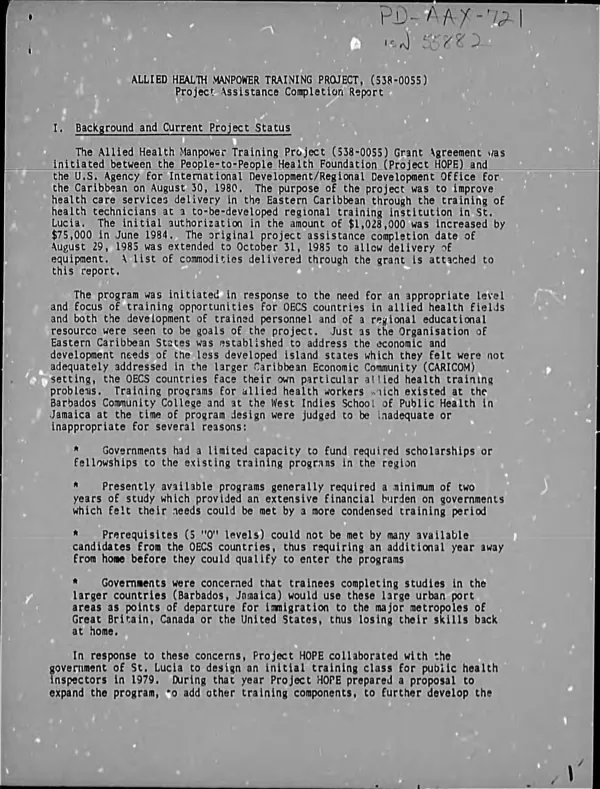
Evaluation covered 1980-4/86 and was based on document review, site visits, a survey of trainees, and interviews with trainees, supervisors, hospital personnel, and island officials. The project succeeded in developing a training facility and training materials (both of which are now being assumed by the Health Sciences Division of the newly established Sir Arthur Lewis Community College) and in providing training to health workers who were not fully qualified to enter more formal and laborious university training. Nearly 100 environmental health officers and environmental health assistants (EHA"s) were trained. Course content and teaching were rated highly by participants. Problems (e.g., inadequate facilities, delays) were concentrated in the early years and improved over time. Despite several factors limiting the effectiveness of the graduates (insufficient equipment and supervision, problems with certification, and a lack of regionally accepted accreditation guidelines), most were willingly accepted by their Ministries of Health for employment, with the exception of a class of St. Lucian EHA"s, of whom 25% had left the field after one year. A dental auxiliary program was discontinued after the mid-term evaluation and the child health program was never inititated (at the request of the St. Lucia government). Funds for these activities were reprogrammed to provide emergency medical training to the Queen Elizabeth Hospital Accident and Emergency Department in Barbados: the skills of 14 physicians, 26 nurses, and 42 emergency medical technicians were successfully upgraded, although there remain some problems, such as poor physical infrastructure and lack of commitment to emergency care (the latter underscoring the important role of social norms and behaviors in effecting developmental change). TA was generally timely and appropriate, but there was excessive turnover among long-term U.S. advisors. The project taught the critical importance of: (1) follow-up, in-service training to maintain and further upgrade health worker skills; (2) on-going internal assessments to ensure that curricula remain relevant; (3) the support and collaboration of local professionals; and, most importantly, (4) participating countries" capacity to absorb the personnel trained. St. Lucia was unable to support the EHA"s and there was no support for dental assistants. The countries continue to express need for these health workers but have overriding budgetary constraints.