USAID. MISSION TO PERU
Alternative development
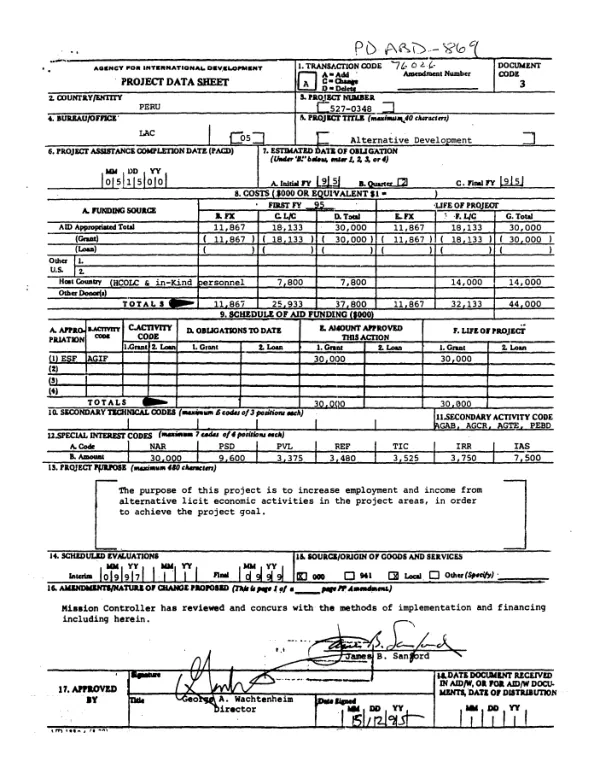
Project to provide economically productive alternatives to illicit coca production in key watershed areas of Peru, initially in Alto Huallaga (Tocache and Uchiza), Aguaytia, Huallaga Central (Ponaza, Biabo, and Sisa), Pichis Palcazu (Pichi and Pachitea), and Apurimac River Valley.
1995
Sign in to readA free account is required to download.
Abstract
The project, to be implemented by the National Development Institute (INADE) through four Special Projects Offices, will comprise three components: (1) employment and income generation; (2) essential services/community development; and (3) environmental protection and awareness. The first component will assist individual farmers and agribusinesses who agree not to grow coca or to reduce existing coca cropping, especially enterprises that can produce relatively short-term returns. Project support will include: (1) applied research and extension by local research institutions, along with parallel efforts to develop high-value cash crops; (2) equipment for research laboratories and improved seed varieties for farmers; (3) TA in developing agro-industrial possibilities; and (4) marketing assistance for farmers. The project will also: (1) establish a Loan Guaranty Fund (LGF) and a Leveraged Matching Fund for Credit to enable intermediate credit institutions (ICIs) to direct credit to farmers and to allow COFIDE, which will manage the LGF, to supply ICI needs for capital; (2) provide capital to strengthen the equity position of rural banks (cajas rurales); and (3) establish a mechanism linking ICIs with farmers and agribusinesses. Second, to improve the environment for legitimate income-producing activities, the project will support small quick-impact community infrastructure and service improvements. Efforts are expected to focus on feeder and access road rehabilitation (coca production thrives in part because its marketing depends solely on air transport), health, education, water and sanitation, small irrigation, community organization and training, environmental conservation and protection, and special efforts such as bridge repair after flooding. Implementing agencies will generally be community organizations and municipal governments. The project will promote grassroots participation in these efforts and local ownership of their results. The third component will combat environmental degradation caused by coca production and thereby enhance prospects for the sustainability of licit alternatives. The project will: support reforestation for hillside protection; establish tree nurseries and agroforestry demonstrations; and seed some deforested areas with pasture. This component will also support TA, training, and an environmental awareness campaign on sound cultivation practices, soil and water management, agricultural sustainability, reforestation, and other environmental conservation practices. Pro-Ag amendment of 8/18/97 increases funding and refocuses project efforts on achieving the key result of increasing voluntary reduction of coca production. To achieve this objective, the project will undertake activities to increase access to basic services and public participation in decisionmaking, growth of the licit economy and economic infrastructure, natural resource/environmental protection, and social communication and narcotics awareness, as well as to institutionally strengthen the Commission to Fight Drugs (CONTRADROGAS). (PD-ABP-936)
Related documents
Documents in this collection
![USAID/Peru strategic objective closeout report : USAID/Peru special objective -- "reduce illicit coca production in target areas in Peru" [SpO] 527-005](https://covers.devme.ai/gen/44205.webp) 2002
2002USAID DEC
USAID/Peru strategic objective closeout report : USAID/Peru special objective -- "reduce illicit coca production in target areas in Peru" [SpO] 527-005
Open record![USAID/Peru strategic objective closeout report : USAID/Peru special objective -- 'reduce illicit coca production in target areas in Peru' [SpO] 527-005](https://covers.devme.ai/gen/5365.webp) 2002
2002USAID DEC