USAID. MISSION TO GUATEMALA
Altiplano higher education project (PRODIPMA)
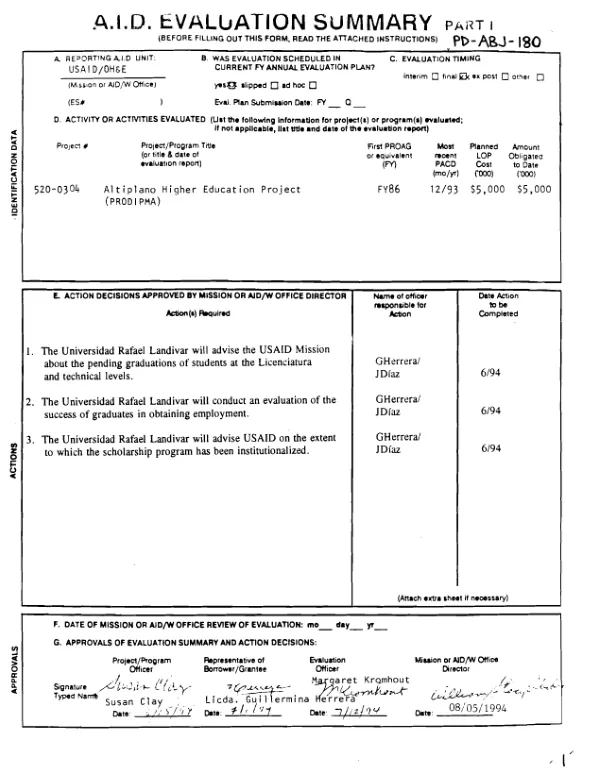
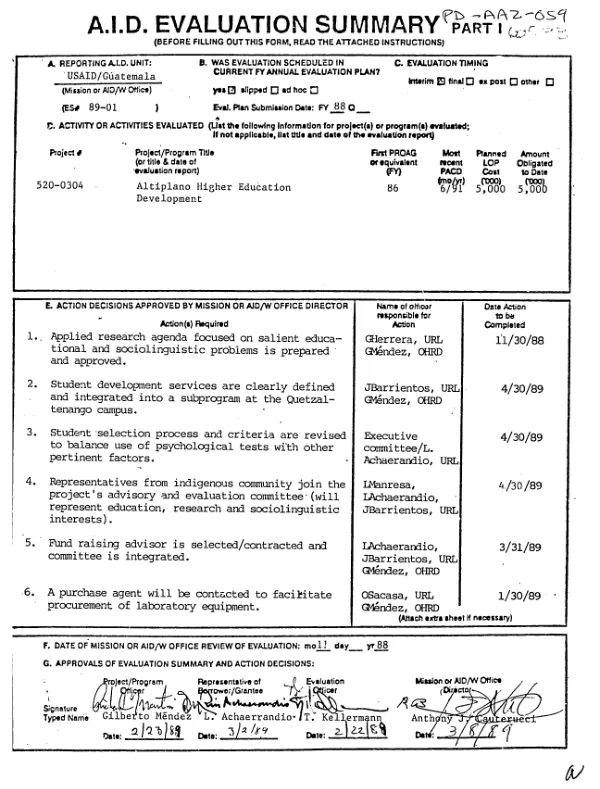
Summarizes attached final evaluation (XD-ABJ-180-A) of a project (1986-12/93) to strengthen the capacity of the Quetzaltenango (highlands) campus of the University Rafael Landivar to implement a higher education program for Mayan-speaking students.
1994
Sign in to readA free account is required to download.
Abstract
The project was a success. By project end, the program will have graduated 73% of the targeted number of students at the licenciatura level in a variety of academic areas (e.g., law, business, educational administration, social work, linguistics, and agriculture) and 101% of the targeted number at the technical level, also in a variety of areas (e.g., cooperatives, bilingual education, mathematics, social work, official translations). A total of 30% of enrollees are women. Project impacts were universally positive. (1) For the indigenous population, the project provided relevant academic programs and an education that helped many to find jobs; a number of graduates now occupy important positions in NGOs and private businesses, and many graduates at the technical level are paying their own way towards a licenciatura degree. (2) For the university, the project strengthened the financial and administrative system of the Quetzaltenango campus; expanded academic programs in bilingual education, legal interpretation, and phytotechnology, as well as faculty, staff, laboratory and library resources; and created a fundraising program, though one lacking a strategic implementation plan. (3) The project has had positive impacts on the home communities of the students, as graduates who attended weekend classes have returned to their communities to work on community development. (4) The program also had a positive impact on local business. Employers indicate that graduates and well-prepared and perform their jobs well. Recommendations are, inter alia, to: institutionalize the program at the Quetzaltenango campus and orient it toward poor populations who meet academic requirements; maintain communication with program graduates through distance education workshops and courses; monitor the selection of scholarship recipients to decrease dropout due to low academic achievement; and establish an in-service training program to upgrade faculty skills. The following lessons were learned. (1) Projects with private entities are implemented more efficiently and effectively than projects implemented with the government. (2) Private entities with a focus on disadvantaged populations are better prepared to implement social development projects than those lacking this focus. (3) To avoid paternalism, scholarship recipients should be required to pay part of their fees through community or university work or student loans. (4) In the interest of program sustainability, a fundraising program should be implemented from the outset.
![Evaluacion final : programa PRODIPMA [programa de desarrollo integral de la poblacion maya]](https://covers.devme.ai/gen/49164.webp)
![Project assistance completion report (PACR) : FUNDAZUCAR [Fundacion del Azucar] girls' education component of the Basic Education Strengthening (BEST) project (no. 520-0374)](https://covers.devme.ai/gen/5889.webp)