MANAGEMENT SCIENCES FOR HEALTH
An Electronic Recording and Reporting System for Improved TB Treatment in Ukraine
The Ukrainian Ministry of Health's electronic recording and reporting system for tuberculosis (TB) treatment was implemented in 2008 to address the country's high TB burden.
2018 · 4 pages
Sign in to readA free account is required to download.
Abstract
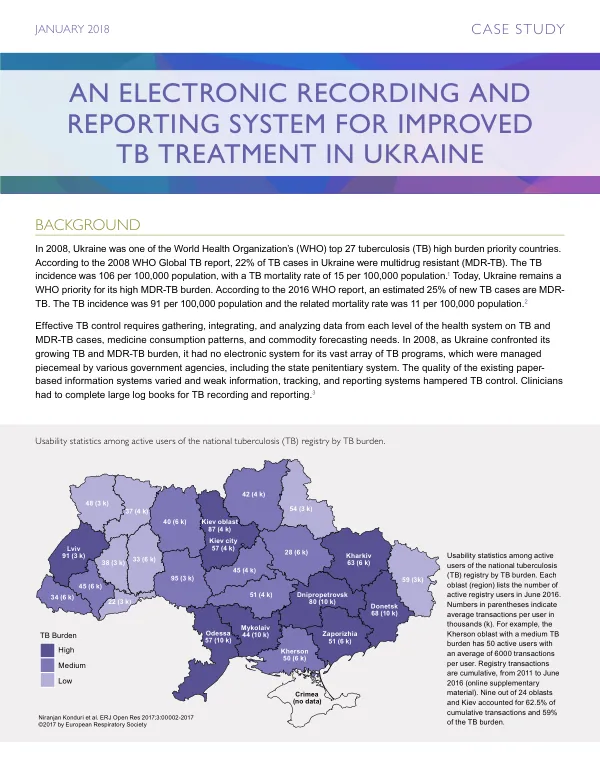
In 2008, Ukraine was one of the World Health Organization's (WHO) top 27 TB high-burden priority countries, with 22% of TB cases being multidrug-resistant (MDR-TB). The TB incidence was 106 per 100,000 population, and the mortality rate was 15 per 100,000 population. The WHO has promoted electronic TB recording and reporting to improve surveillance and support decision-making based on accurate, timely, and useful information. The e-TB Manager system, developed by Management Sciences for Health (MSH) with funding from the US Agency for International Development (USAID), integrates data across all components of TB control, including information on people with presumptive TB, patients, medicines, laboratory testing, diagnosis, treatment, and outcome. The e-TB Manager system was piloted in six oblasts (regions) over a three-year period, starting in 2009. Data entry began with the entry of 5,000 cases in the first two years and expanded to more routine entry from all pilot sites, with 67,000 cases entered. The system was implemented nationwide by 2014, and data are entered on a regular basis according to approved standard operating procedures. The implementation of the e-TB Manager system has resulted in several benefits, including a decrease in the average time needed to prepare and complete facility-, regional-, and national-level TB reports from several days to a few hours. Compliance between national standardized quarterly reporting and the same report generated by e-TB Manager increased from 77% in the third quarter of 2013 to 98% in the first quarter of 2014. The system also enables doctors to better track patients and get a more complete picture of their medical history, which was challenging with a paper-based system. Training for public health workers was necessary to take into account poor computer literacy and some initial resistance to using an electronic system. To help train users, SIAPS hired a local consulting company specializing in adult learning techniques and training of trainers methodologies. The company's job was to train oblast-level officials to run educational programs on e-TB Manager by themselves. Six training of trainers sessions were organized between August 2013 and September 2014 in Kiev city. The Global Fund to Fight AIDS, Tuberculosis and Malaria and USAID supported the purchase of 534 computers, while the government of Ukraine provided internet connectivity in each oblast. The UCDC assigned a dedicated team of supervisors to lead the national scale-up of e-TB Manager and ensure that doctors, nurses, pharmacists, and health workers received needed support. A full-time IT staff at the UCDC provides real-time national helpdesk services on demand via phone, email, and a group discussion forum. To promote data quality, SIAPS and the UCDC jointly developed an assessment protocol to help ensure error-free registry and reporting. As of July 2016, 227,657 cases had been entered in the registry, with a data entry consistency rate with the original paper-based reports of approximately 99%. In 2015, the project conducted a cross-sectional, anonymous, nationwide survey to assess the overall user experience of the registry. Users gave high ratings to the registry's ability to help improve case management, and there was a generally high rating for improved workplace productivity. Implementing a digital health tool such as e-TB Manager, particularly in large and complex high-burden TB settings, requires strong partnerships, organizational agility, and committed resources for success and sustainability. The project needed at least five years to build sustained individual user and institutional capacity to use the registry in Ukraine.
Related documents