USAID DEC
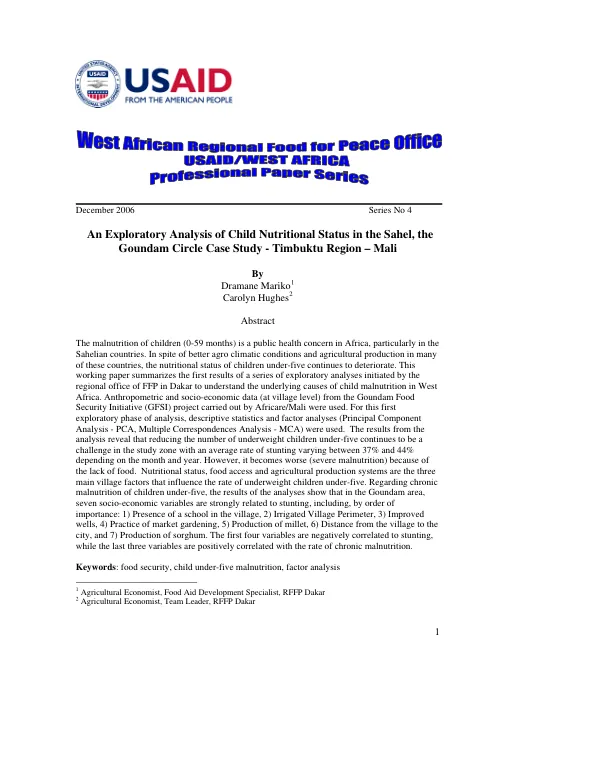
An exploratory analysis of child nutritional status in the Sahel, the Goundam Circle case study - Timbuktu region - Mali
Sign inUSAID. WEST AFRICAN REGIONAL FOOD FOR PEACE OFC.
An exploratory analysis of child nutritional status in the Sahel, the Goundam Circle case study - Timbuktu region - Mali
The malnutrition of children (0-59 months) is a public health concern in Africa, particularly in the Sahelian countries.
Mariko, Dramane; Hughes, Carolyn · 2006
Sign in to readA free account is required to download.
Abstract
In spite of better agro climatic conditions and agricultural production in many of these countries, the nutritional status of children under-five continues to deteriorate. This working paper summarizes the first results of a series of exploratory analyses initiated by the regional office of FFP in Dakar to understand the underlying causes of child malnutrition in West Africa. Anthropometric and socio-economic data (at village level) from the Goundam Food Security Initiative (GFSI) project carried out by Africare/Mali were used. For this first exploratory phase of analysis, descriptive statistics and factor analyses (Principal Component Analysis -- PCA, Multiple Correspondences Analysis -- MCA) were used. The results from the analysis reveal that reducing the number of underweight children under-five continues to be a challenge in the study zone with an average rate of stunting varying between 37% and 44% depending on the month and year. However, it becomes worse (severe malnutrition) because of the lack of food. Nutritional status, food access and agricultural production systems are the three main village factors that influence the rate of underweight children under-five. Regarding chronic malnutrition of children under-five, the results of the analyses show that in the Goundam area, seven socio-economic variables are strongly related to stunting, including, by order of importance: (1) presence of a school in the village; (2) irrigated Village Perimeter; (3) improved wells; (4) practice of market gardening; (5) production of millet; (6) distance from the village to the city; and (7) production of sorghum. The first four variables are negatively correlated to stunting, while the last three variables are positively correlated with the rate of chronic malnutrition. (Author abstract, modified)
Related documents
Documents in this collection
 2008
2008USAID DEC
Understanding child malnutrition in the Sahel : a case study from Goundam Cercle, Timbuktu region, Mali
Open record 2002
2002USAID DEC
![Nutrition and health status of young children and their mothers in Mali : findings from the 1995/96 Mali demographic and health survey [DHS]](https://covers.devme.ai/gen/45157.webp)