CALIFORNIA POLYTECHNIC STATE COLLEGE
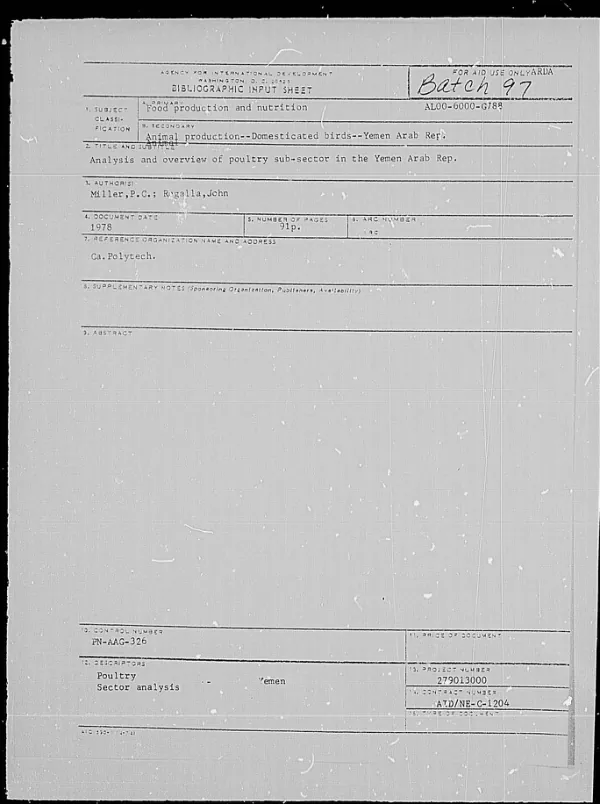
ANALYSIS AND OVERVIEW OF POULTRY SUB-SECTOR IN THE YEMEN ARAB REP.
Provides an overview of the USAID-supported poultry industry in Sana"s and Taiz, Yemen, and gives recommendations to assist in its growth.
MILLER, P. C.; ROGALLA, JOHN · 1970
Sign in to readA free account is required to download.
Abstract
During the period 3/8/78-4/7/78, the authors visited all large and medium poultry operations in the country as well as several small operations. They interviewed managers and owners, performed a limited demand survey in Sana"s, and collected price information. Inputs to the poultry industry, their costs and availability, are detailed. Budgets and cost/benefit ratios are developed for village and commercial flocks of medium and large sizes, for both egg and poultry production. Yeman"s poultry industry is based on imports - chicks, feed, equipment, technical assistance, medicants, building materials, and many other production items. The greatest weakness in the poultry industry is the lack of basic husbandry knowledge. Common problems discovered were: lack of ventilation, crowded conditions, and poor quality feed. This is where the USAID project can be most effective; i.e., in draining poultrymen and extension agents. Also, the Yeman government should establish a poultry extension service. The authors predict that, in the future, broiler production, with its higher profit potential, will expand greatly. Egg production will begin and increase at a slower rate due to the importation of the competitive product. The report includes 23 appendices describing the current status of Yemen"s poultry industry and the projected production and import of poultry meat and eggs, as well as proposed locations and methods of operation. Also appended are a bibliography and a list of individuals who contributed to the report.
![Market-oriented farm support activity [MOFSA] : evaluation and recommendations for the Vologda [Russia] dairy industry](https://covers.devme.ai/gen/59433.webp)