AGRICULTURAL DEVELOPMENT COUNCIL, INC.
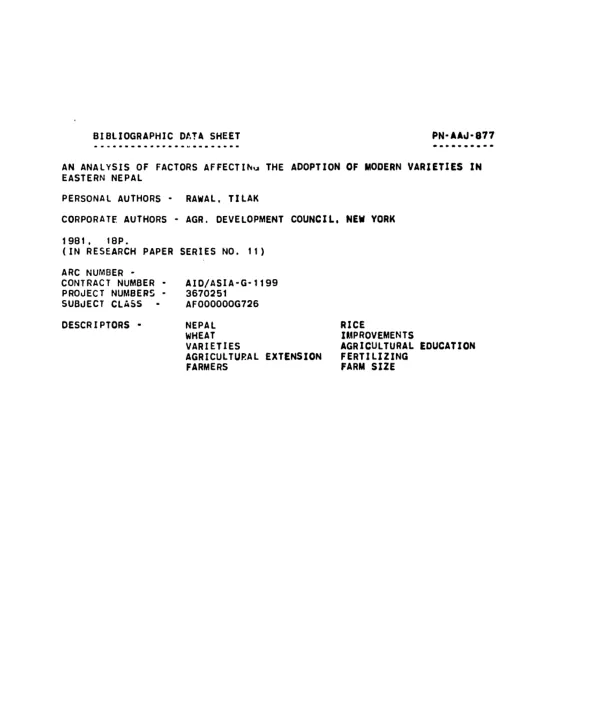
ANALYSIS OF FACTORS AFFECTING THE ADOPTION OF MODERN VARIETIES IN EASTERN NEPAL
Due to land constraints, Nepal requires yield-increasing technology to maintain food self-sufficiency.
RAWAL, TILAK · 1970
Sign in to readA free account is required to download.
Abstract
Although rice is Nepal"s main farm income crop, yield per hectare is less than 2 tons due to the lack of modern seed varieties (MV"s), fertilizer technology, and controlled irrigation. This paper analyzes variability in the adoption of rice and wheat MV"s and in the use of chemical fertilizer in Nepal"s Morang and Sunsari provinces. Data were collected and analyzed with the help of multiple linear regressions. Rice MV"s were found to have a 30% higher yield than local varieties (LV"s); a comparison of wheat varieties was impossible as wheat LV"s are no longer grown. The factors identified as influencing MV rice adoption include farm size; proportion of low land to total land; proportion of farm irrigated; size of available family labor force; operator"s education; contact with extension agents; number of years since MV rice was first used; and the farmers use of institutional credit. These same factors, especially irrigation, influenced the adoption of MV wheat. Possible explanations for the slow adoption of MV rice are the existence of established markets for LV rice and the difficulty of drying high- moisture MV rice during monsoon periods. Furthermore, the main MV rice variety grown in Nepal is IR8, considered less palatable and more susceptible to insects than LV"s. Labor requirements are similar for LV and MV rice production, but hired labor, as distinct from family labor, is used to a greater extent with MV"s. Variability factors on the use of chemical fertilizers include cost, experience use, area planted with MV"s, farm size, and credit. Research is needed to replace IR8, while investment in irrigation, education, and extension programs could expand the type of environment in which MV"s are best adopted. Five illustrative tables and a 13-item reference list (1954-79) is included.