UNIVERSITY OF MICHIGAN. CENTER FOR RESEARCH ON ECONOMIC DEVELOPMENT
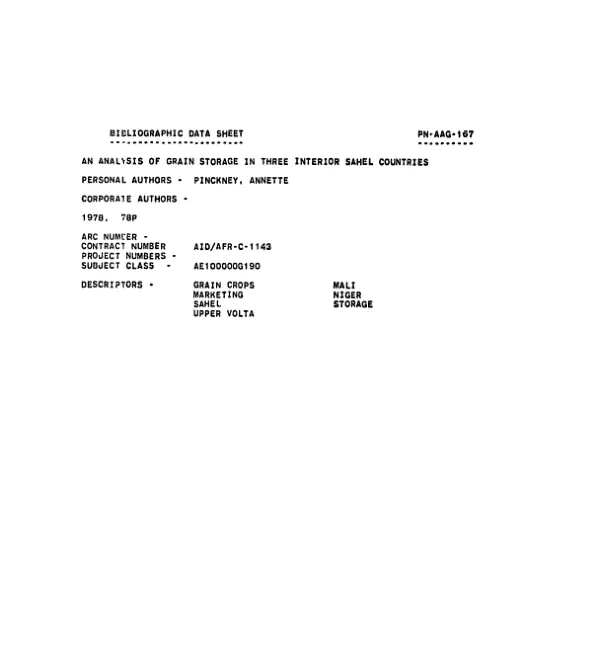
Analysis of grain storage in three interior SAHEL countries
Marketing expected increases in foodgrain production will require viable grain storage systems in Mali, Niger, and Upper Volta.
Pinckney, Annette M. · 1970
Sign in to readA free account is required to download.
Abstract
This report analyzes current grain storage systems in the three Sahelian countries and raises key policy issues. In Mali, domestic grain is transported to arrondissement and then to provincial storage centers whose estimated national capacity is 130,000 metric tons (MT). The State Marketing Board, OPAM, transfers 8% of all millet and 30% of rice to widely used central warehouses. While this system saves money, the lack of decentralized warehousing increases transport burdens on suppliers and leads to an unquantified loss of grain in shipping. Mali has no current (1978) grain reserves. In Niger, responsibility for storing grain lies with the National Grain Agency (OPVN), which stores 90% of all grain collected, the rest being stored by local co-ops. Arrondissement storage capacity is estimated at 9,000 MT and total OPVN capacity is 70,000 MT. Niger has 15,000 MT of millet and sorghum on emergency reserve. Although grain storage in Upper Volta officially rests with the Regional Development Office (ORD), two other national agencies control significant amounts of the nation"s total storage capacity and reserves. While precise statistics are lacking, it is estimated that ORD"s capacity is 20,800 MT and that of the other agencies 37,000 MT. Upper Volta enjoys a 6-week grain reserve. All three countries need to quantify grain reserve capacity and grain losses, end the fragmentation of authority in the storage sector, and bring uniformity to storage facilities. Other issues facing the three countries are: (1) the level at which new investments in storage infrastructure should be initiated (on-farm, community, or national); (2) tradeoffs in national grain reserve policies between efficiency and welfare and between recipients; (3) the composition of grain reserves (i.e., percentage of each grain variety relative to another) and the implications for different grain producers; and (4) questions concerning price policy coordination, institutional structure, appropriate storage technology, and location of facilities in Sahelian long-term grain reserve programs.