USAID DEC
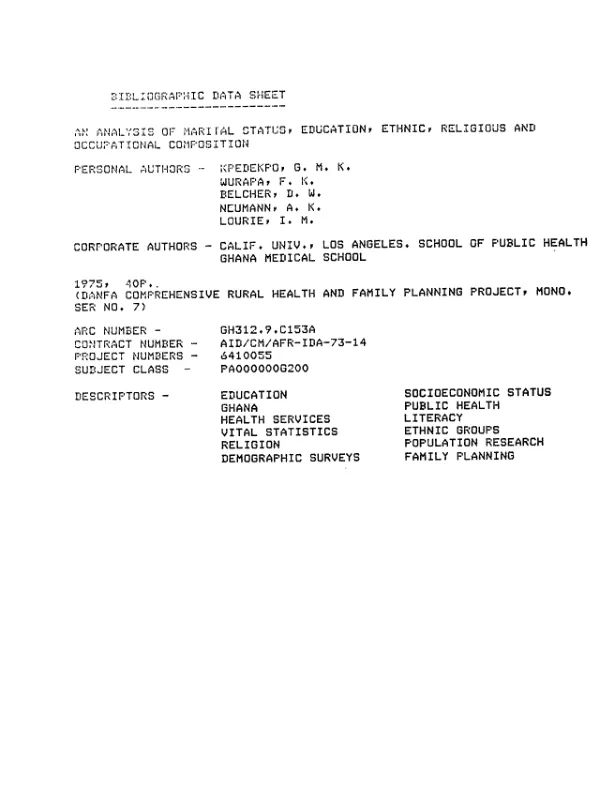
ANALYSIS OF MARITAL STATUS, EDUCATION, ETHNIC, RELIGIOUS AND OCCUPATIONAL COMPOSITION
Sign inUNIVERSITY OF CALIFORNIA AT LOS ANGELES. SCHOOL OF PUBLIC HEALTH
ANALYSIS OF MARITAL STATUS, EDUCATION, ETHNIC, RELIGIOUS AND OCCUPATIONAL COMPOSITION
Several monograph papers have been written to inform concened U.S.
KPEDEKPO, G. M.; WURAPA, F. K. · 1970
Sign in to readA free account is required to download.
Abstract
and African agencies of experience gained from the Danfa Comprehensive Rural Health and Family Planning Project, a project designed to demonstrate and test new low-cost health delivery systems in Ghana. As part of the research component of the project, this report describes selected social and economic variables for marriage, education, ethnic, religious, and occupation characteristics of the population in the project"s four study areas. These study areas, comprising 50,000 rural inhabitants living 10-50 miles from Accra, are defined by the type of health service administered (comprehensive, health education, family planning, and standard). The pattern of marriage is surprisingly similar in all four areas: age at marriage for both males and females was estimated at 23.7, 23.4, 22.6, and 23.9 years for areas one, two. three, and four and five respectively. There does exist a differential in the male and female ages at marriage, but this differential is essentially the same in all areas. There is considerable differential among the educational and literacy levels from one project area to another, with area one in the favoured position relative to the other three areas. With respect to ethnic composition, all project areas show significant variations in the proportion of the population who are Akwapim, Ewe, or non-Ghanaian. In addition, areas two and three have a large number of residents who follow traditional religion practices. Although the major occupation of persons economically active in all four project areas is farming and other agricultural activities, the proportion employed in farming in each area does not vary greatly. Several graphs and charts are provided to illustrate the data. Four entries (1953, 1968) are cited for further reference.