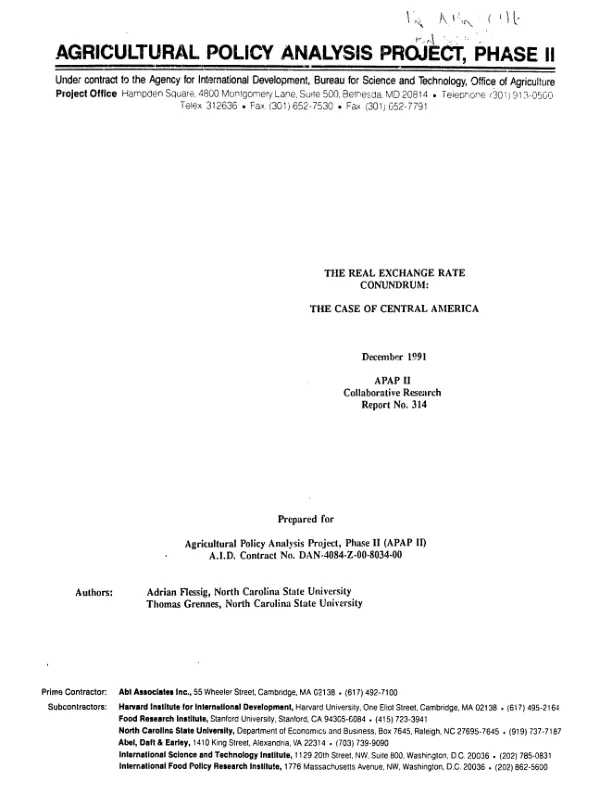
ABT ASSOCIATES, INC.
Analysis of the real exchange rate in Costa Rica
The real exchange rate has been identified as an important variable in a small open economy like Costa Rica"s.
Grennes, Thomas · 1992
Sign in to readA free account is required to download.
Abstract
An increase in inflation after 1974 caused the colon to become overvalued, and persistent inflation after the devaluation of 1981 made the abandonment of fixed exchange rates unavoidable. The managed float of the 1980"s was associated with an increase in volatility of Costa Rica"s real exchange rate. This paper analyzes alternative exchange rate concepts and methods of measurement. Some new real exchange rate indexes are calculated for the colon for the period 1962-88. They are compared with each other and with indexes published by the IMF, the World Bank, and Economic Commission for Latin America and the Caribbean (ECLAC). The sensitivity of real exchange rate indexes to changes in price indexes and official versus black market exchange rates is analyzed. Bilateral rates with the U.S. dollar are compared with multilateral rates with 10 trading partners. The use of geometric versus arithmetic means for prices and exchange rates is also considered. The relationship between the proxy for the tradables/non-tradables price ratio and other indexes is shown. The multilateral geometric index using wholesale prices has advantages over alternative measures. (Author abstract)
Connected topics
Related documents