FHI 360
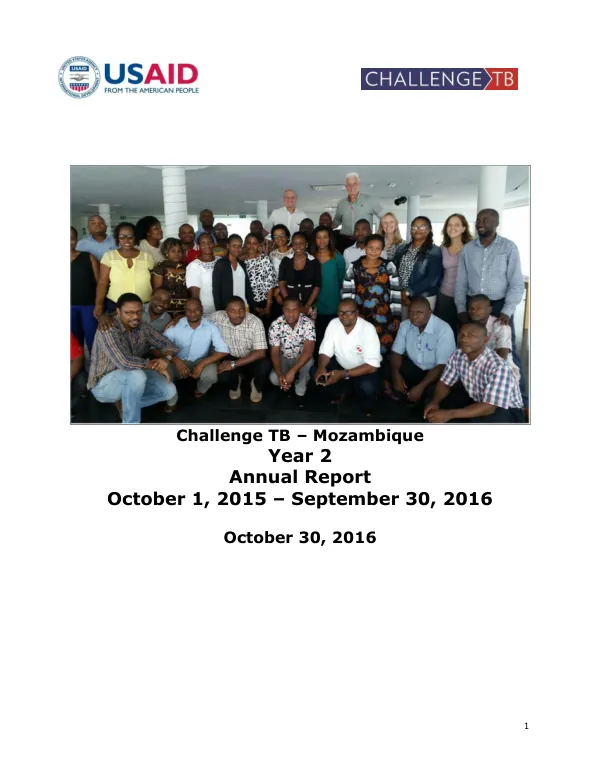
Annual Report: Challenge TB – Mozambique Year 1
The Challenge TB project in Mozambique is a five-year global project funded by the United States Agency for International Development (USAID) and implemented by the Challenge TB partnership with KNCV Tuberculosis Foundation (KNCV) as the prime.
2015 · 55 pages
Sign in to readA free account is required to download.
Abstract
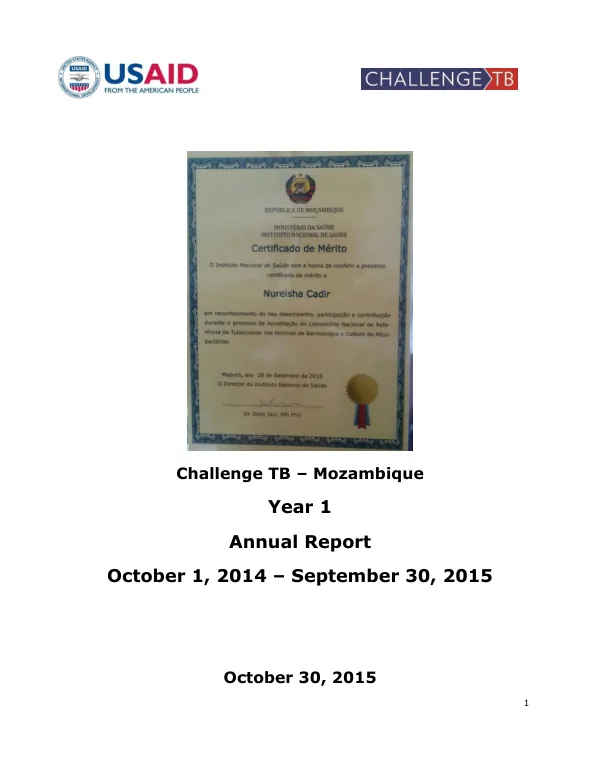
The project builds upon previous USAID tuberculosis (TB) prevention and treatment efforts. In Mozambique, the implementation of CTB is led by FHI 360 with KNCV as the only coalition partner. FHI 360 provides technical leadership to the project, ensuring coordination, management, and monitoring of project activities at the country level. The project focuses on technical assistance to the National Tuberculosis Program (NTP) at central and provincial levels, including training health professionals on Multidrug Resistant Tuberculosis (MDR-TB) and pediatric TB, laboratory interventions, strengthening health systems for TB care, and monitoring and evaluation. The project has received support from the NTP to implement Community-Based Directly Observed Treatment, Short-Course (CB DOTS) in 64 districts across four provinces in the Northern Central regions of the country. Given the short time frame for Year 1 implementation, the project team prioritized activities that would bear fruit over the next four years of the CTB project. The project team encountered more stringent FHI 360 contracting requirements compared to those under TB CARE I, which delayed the completion of contracts with community partners. Despite this, the project has steadily solidified its activities in APA 1, with key achievements including the accreditation of the National Reference Laboratory (NRL) in March 2015. The project has established a close working relationship with the NTP, USAID, other relevant departments of the Mozambique Ministry of Health (MOH), KNCV, and other collaborating partners to ensure agreed-upon project activities are implemented in line with the NTP national strategic plan 2014-2018. The project will be implemented from 2015 to 2019, with APA 1 implemented over a six-month period between April and September 2015 due to the delay in approval of the CTB Year 1 work plan. The project has received support from the NTP to implement CB DOTS in 64 districts across four provinces in the Northern Central regions of the country. The implementation of CB DOTS will commence in Year 2 once the sub-awards process is completed and contracts are signed with the six selected implementing partners. The project has prioritized activities that will bear fruit over the next four years of the CTB project, including key TA activities that did not require completion of contracts with community partners. The project has established a strong partnership with the NTP, USAID, and other relevant stakeholders to ensure the successful implementation of the project. The project has made significant progress in APA 1, despite the challenges encountered, and is well-positioned to achieve its objectives in the remaining years of the project. The project's focus on technical assistance, training, and laboratory interventions will help to strengthen the national reference laboratory and NTP M&E systems, ultimately contributing to the reduction of TB cases in Mozambique. The project's implementation will be critical in achieving the national strategic plan 2014-2018, which aims to reduce TB cases by 50% by 2018. The project's focus on CB DOTS will help to increase access to TB care and treatment, particularly in rural areas where access to healthcare services is limited. The project's partnership with the NTP and other stakeholders will ensure the successful implementation of the project and the achievement of its objectives. The project's success will depend on the effective implementation of its activities, including the training of health professionals, laboratory interventions, and monitoring and evaluation. The project's partnership with the NTP and other stakeholders will be critical in ensuring the successful implementation of the project and the achievement of its objectives. The project's focus on technical assistance, training, and laboratory interventions will help to strengthen the national reference laboratory and NTP M&E systems, ultimately contributing to the reduction of TB cases in Mozambique.
Related documents