CREATIVE ASSOCIATES INTERNATIONAL INC.
Annual Report: Community Cohesion Initiative, October 2013 – September 2014
The Community Cohesion Initiative (CCI) was launched in March 2012 by the United States Agency for International Development's (USAID) Office of Transition Initiatives (OTI) and Creative Associates International, Inc.
2014 · 14 pages
Sign in to readA free account is required to download.
Abstract
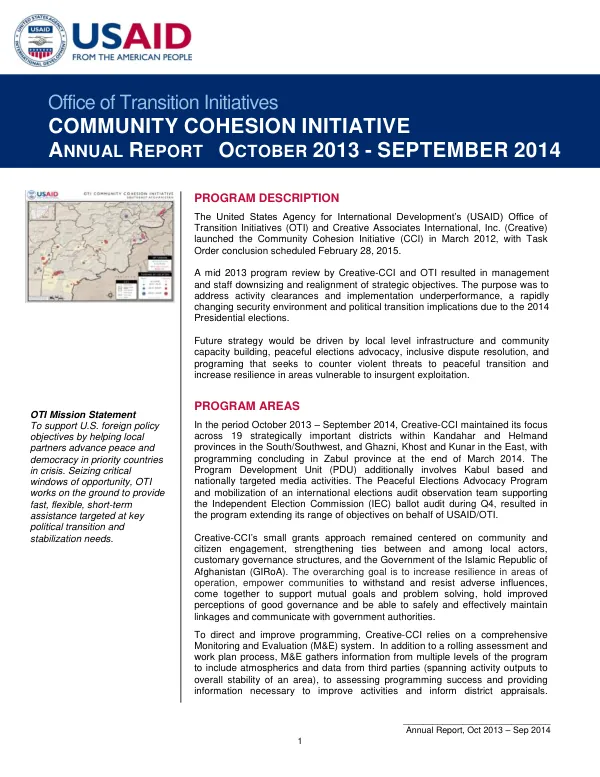
(Creative). The initiative aimed to increase resilience in areas of operation, empower communities to withstand and resist adverse influences, and promote good governance in Afghanistan. The program's focus was on community and citizen engagement, strengthening ties between local actors, customary governance structures, and the Government of the Islamic Republic of Afghanistan (GIRoA). In the period October 2013 – September 2014, Creative-CCI maintained its focus across 19 strategically important districts within Kandahar and Helmand provinces in the South/Southwest, and Ghazni, Khost, and Kunar in the East. The program's Peaceful Elections Advocacy Program and mobilization of an international elections audit observation team supporting the Independent Election Commission (IEC) ballot audit resulted in the program extending its range of objectives on behalf of USAID/OTI. Creative-CCI's small grants approach remained centered on community and citizen engagement, strengthening ties between and among local actors, customary governance structures, and the GIRoA. The program's overarching goal was to increase resilience in areas of operation, empower communities to withstand and resist adverse influences, come together to support mutual goals and problem-solving, hold improved perceptions of good governance, and be able to safely and effectively maintain linkages and communicate with government authorities. The program relied on a comprehensive Monitoring and Evaluation (M&E) system to direct and improve programming. M&E gathered information from multiple levels of the program, including atmospherics and data from third parties, to assess programming success and provide information necessary to improve activities and inform district appraisals. The security situation in Afghanistan remained challenging during the reporting period, with escalating insurgent activity in the Eastern, South Eastern, and Southern regions. The Afghan Public Protection Force (APPF) administrative changeover to the Ministry of Interior (MOI) was completed in July, and expatriate staff movement remained limited and unchanged from the previous quarter. The presidential election runoff and subsequent vote audit were marked by high security, with tensions and arguments between rival parties culminating in an outcome achieved under strained circumstances. The International Security Assistance Forces (ISAF) and a combined effort of all Afghan National Security Force (ANSF) elements oversaw the audit security effort, which was supervised by the United Nations (UN). The program's Peaceful Elections Advocacy Advisors provided first-hand knowledge and assessment of local and national political dynamics, traveling to all five provinces supervising pre- and post-elections focus group activities and community dialogue training. In collaboration with the Program Development Unit (PDU) and the Media and Strategic Communications Unit, a comprehensive media outreach messaging strategy was developed and disseminated by the Kabul office and through local NGO partners. Between July and September 2014, Creative-CCI cleared, completed, or closed 47 small grants, with a breakdown by sector as follows: Infrastructure (0 grants), Media (3 grants), Socio-Cultural (2 grants), Technical Assistance (0 grants), and Training (42 grants). Since March 2012, OTI, through its implementing partner Creative-CCI, has cleared, completed, or closed 704 small grants, with a breakdown by sector as follows: Infrastructure (295 grants), Media (41 grants), Socio-Cultural (138 grants), Technical Assistance (66 grants), and Training (164 grants).